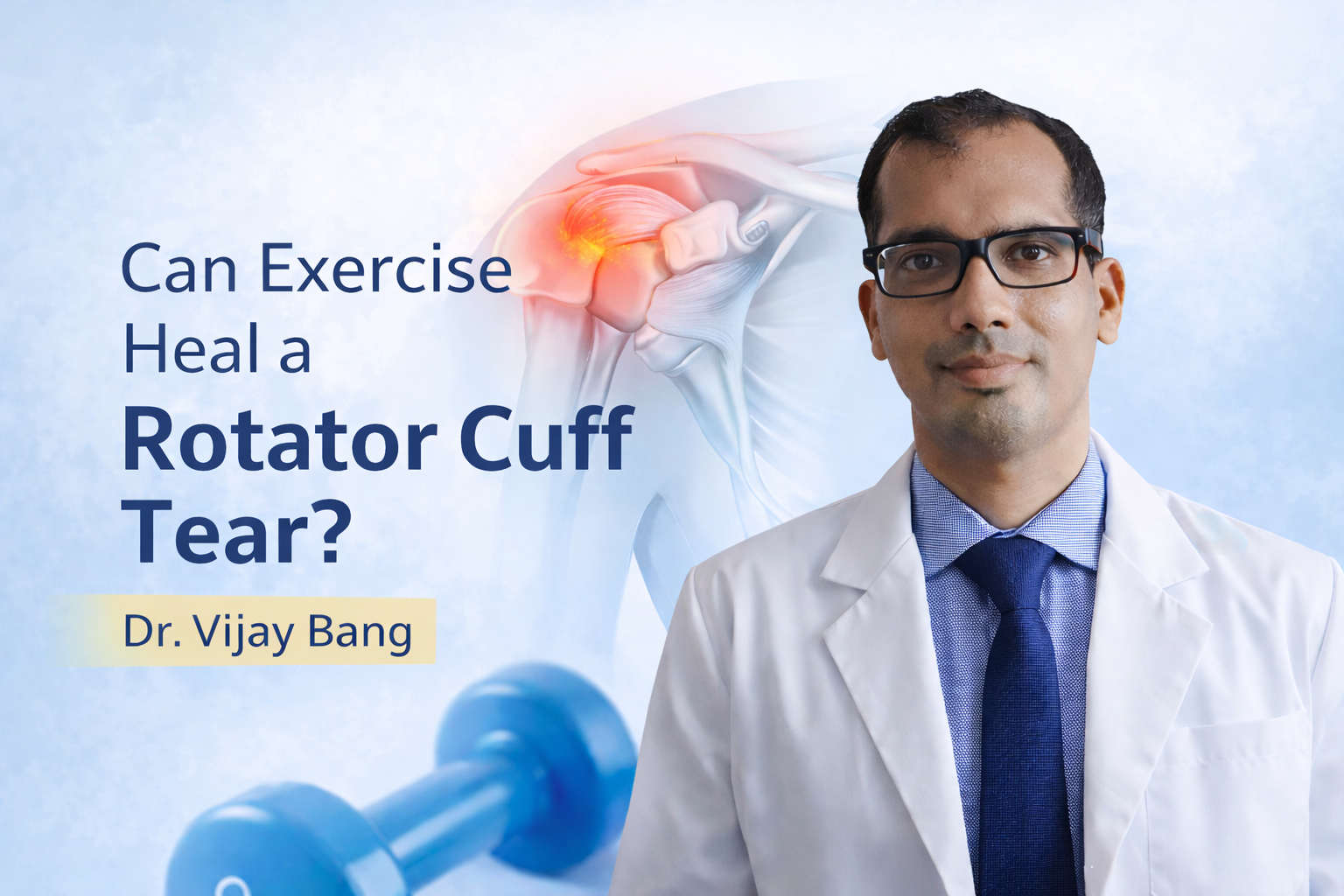
Dr Vijay Bang, leading rotator cuff specialist in Ahmedabad, explains shoulder pain is one of the most common musculoskeletal complaints in adults. When imaging confirms a rotator cuff tear, the immediate question many patients ask is:
“Can exercise heal this tear?”
The answer is nuanced.
Exercise plays a powerful role in managing rotator cuff injuries. In some cases, it can significantly reduce pain and restore function. However, exercise does not physically “reattach” a completely torn tendon to bone. Understanding what exercise can and cannot do is essential for making informed decisions about treatment.
Understanding a Rotator Cuff Tear
The rotator cuff is composed of four muscles and their tendons that stabilize the shoulder joint and allow lifting and rotation of the arm. These tendons attach muscle to bone.
A rotator cuff tear occurs when one or more tendons are damaged. Tears may be:
- Partial thickness tears (incomplete damage)
- Full thickness tears (complete detachment from bone)
- Small, medium, large, or massive
The body’s ability to heal depends on the type and severity of the tear.
What Does “Healing” Actually Mean?
Before discussing exercise, it is important to define healing.
True structural healing means:
- The torn tendon reattaches to the bone
- The tendon regains its original strength
- Normal anatomy is restored
Symptomatic improvement, on the other hand, means:
- Pain decreases
- Strength improves
- Function returns
Exercise can often improve symptoms, but it does not typically reverse structural detachment in full-thickness tears.
Can Exercise Heal a Partial Rotator Cuff Tear?
Partial tears often respond well to structured rehabilitation.
In these cases, exercise can:
- Reduce inflammation
- Improve shoulder mechanics
- Strengthen surrounding muscles
- Reduce stress on the injured tendon
- Improve pain and function
Some small partial tears may stabilize and become asymptomatic with consistent physiotherapy.
However, even in partial tears, imaging may still show tendon irregularity despite symptom improvement.
Can Exercise Heal a Full-Thickness Tear?
Full-thickness tears involve complete detachment of the tendon from bone. Tendons have limited blood supply, which reduces their natural healing potential.
Scientific evidence shows:
- Exercise cannot reattach a fully detached tendon.
- Structural healing does not occur without surgical repair.
- Symptom relief is still possible in selected cases.
Many patients with small or medium full-thickness tears experience reduced pain and improved strength through rehabilitation alone.
The tendon remains torn, but surrounding muscles compensate.
Why Exercise Can Still Work (Even If It Doesn’t Reattach the Tendon)
The shoulder is a highly dynamic joint. Multiple muscles work together to maintain stability.
When a rotator cuff tendon is torn:
- Other intact muscles can compensate
- The deltoid muscle may assist in lifting
- Scapular stabilizers improve shoulder positioning
- Biomechanics can be optimized
This compensatory mechanism explains why some patients function well despite a tear.
Evidence From Clinical Studies
Several long-term studies have evaluated non-surgical management of rotator cuff tears.
Research shows:
- Many patients with small degenerative tears improve with physiotherapy.
- Pain reduction and functional improvement are common outcomes.
- Tear size may increase over time in some patients.
- Some individuals eventually require surgery.
Outcomes vary depending on age, tear size, muscle quality, and adherence to therapy.
When Exercise Alone Is Often Sufficient
Exercise may be appropriate when:
- The tear is partial or small
- Symptoms are mild to moderate
- Strength is largely preserved
- Daily activities remain manageable
- The patient prefers non-surgical treatment
Close monitoring is essential.
When Exercise Is Less Likely to Be Enough
Exercise alone may not be sufficient when:
- There is sudden traumatic injury
- Significant weakness is present
- The arm cannot be lifted properly
- The tear is large or massive or rim rent tear
- Symptoms worsen despite therapy
- MRI shows muscle atrophy or fatty degeneration
In these cases, delaying surgery may reduce healing potential.
The Risk of Tear Progression
One important consideration is tear enlargement.
Some studies indicate:
- Small tears may increase in size over time.
- Larger tears have higher risk of muscle degeneration.
- Chronic tears may become irreparable.
Exercise can control symptoms but does not always stop structural progression.
What Happens Inside the Shoulder During Rehabilitation?
Rehabilitation focuses on:
- Pain control
- Restoring mobility
- Strengthening intact muscles
- Improving scapular mechanics
- Restoring functional patterns
The goal is optimizing what remains intact rather than reversing the tear itself.
Typical Exercise Program for Rotator Cuff Injury
A structured program includes:
Phase 1: Pain Reduction
- Gentle range-of-motion exercises
- Pendulum exercises
- Postural correction
Phase 2: Strength Restoration
- Rotator cuff strengthening
- Scapular stabilizer strengthening
- Resistance band exercises
Phase 3: Functional Training
- Overhead control exercises
- Sport- or job-specific movements
Programs must be individualized and supervised when possible.
Can Exercise Prevent Surgery?
In selected patients, yes.
Some individuals with small tears avoid surgery long-term because:
- Pain becomes manageable
- Function returns to acceptable levels
- Daily activities are not restricted
However, the decision depends on functional goals.
A professional athlete may choose surgery earlier than a sedentary individual.
Does Age Matter?
Age influences tendon quality and healing potential.
Younger patients with traumatic tears often benefit from early surgical repair because:
- Tissue quality is better
- Healing potential is higher
- Long-term shoulder demands are greater
Older patients with degenerative tears may respond well to conservative care.
Can Exercise Reverse Fatty Degeneration?
No.
Fatty infiltration of muscle — which occurs in chronic tears — is generally irreversible.
Exercise may improve function but does not convert fat back into healthy muscle tissue.
What About Pain Relief?
Exercise reduces pain by:
- Improving joint stability
- Reducing inflammation
- Enhancing neuromuscular control
- Strengthening supportive muscles
Pain relief does not necessarily equal structural healing.
The Role of Imaging
MRI helps determine:
- Tear size
- Tendon retraction
- Muscle atrophy
- Fatty degeneration
These factors influence whether exercise alone is reasonable.
Long-Term Outcomes: Surgery vs Exercise
Both approaches have evidence supporting them.
Surgery aims to restore anatomy.
Exercise aims to optimize function without restoring anatomy.
In many moderate tears:
- Pain relief may be similar in short-term follow-up.
- Strength recovery may be better with repair in certain cases.
- Larger tears tend to benefit more from surgery.
Treatment must be individualized.
Common Misconceptions
“If pain improves, the tear is healed.”
Not necessarily. The tear may still exist.
“Exercise will always prevent surgery.”
Not always. Some tears progress despite therapy.
“Surgery is always required.”
Incorrect. Many patients function well without surgery.
Frequently Asked Questions
Can exercise heal a rotator cuff tear completely?
Exercise can improve symptoms and function, especially in partial tears. However, full-thickness tears do not reattach naturally without surgical repair.
Is physiotherapy effective for rotator cuff tears?
Yes, physiotherapy is effective in many cases, particularly small and degenerative tears. It strengthens surrounding muscles and improves shoulder mechanics.
How long should I try exercise before considering surgery?
Typically, 3–6 months of structured rehabilitation is recommended unless there is severe weakness or acute traumatic injury requiring earlier intervention.
Can a full-thickness tear improve without surgery?
Symptoms may improve, but the structural defect remains. Some patients function well despite a persistent tear.
Does exercise prevent tear enlargement?
Exercise may improve shoulder mechanics but does not guarantee prevention of tear progression.
Is surgery better than exercise?
It depends on tear size, symptoms, patient age, and functional demands. Both options have evidence supporting their use in appropriate cases.
The Honest Conclusion
Exercise is a powerful tool in managing rotator cuff tears. It can reduce pain, improve strength, and restore daily function in many patients. However, exercise does not reattach a fully torn tendon to bone.
For small or partial tears, rehabilitation may be sufficient. For larger, traumatic, or progressive tears, surgical repair may offer better long-term structural outcomes.
The key lies in individualized assessment, understanding tear severity, and aligning treatment with functional goals.
Early evaluation and informed decision-making lead to the best results — whether that path involves structured exercise or surgical repair.