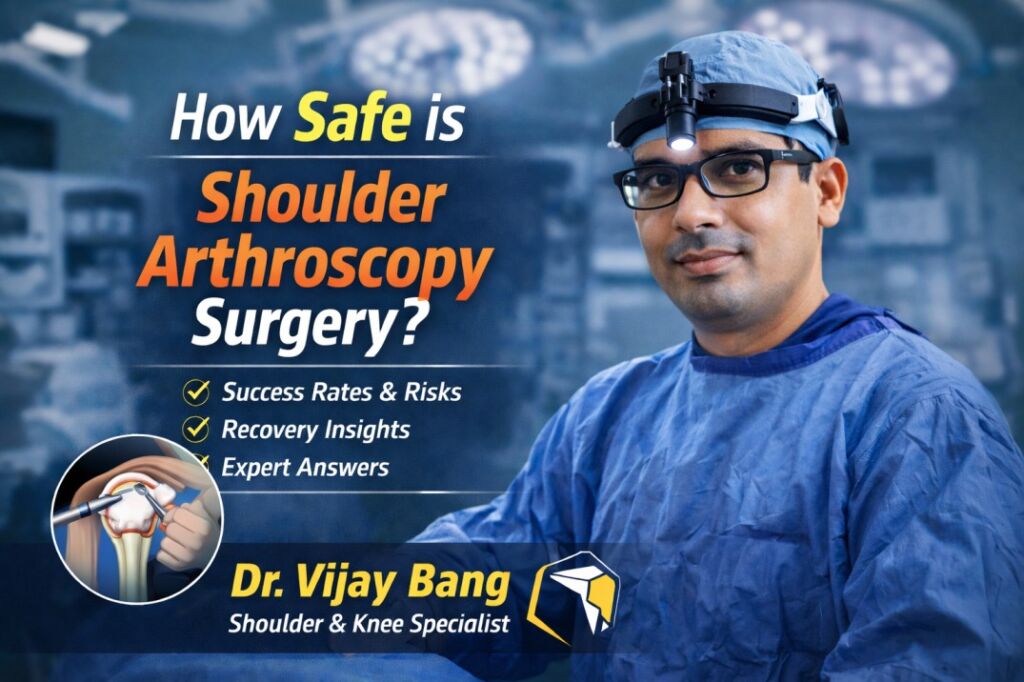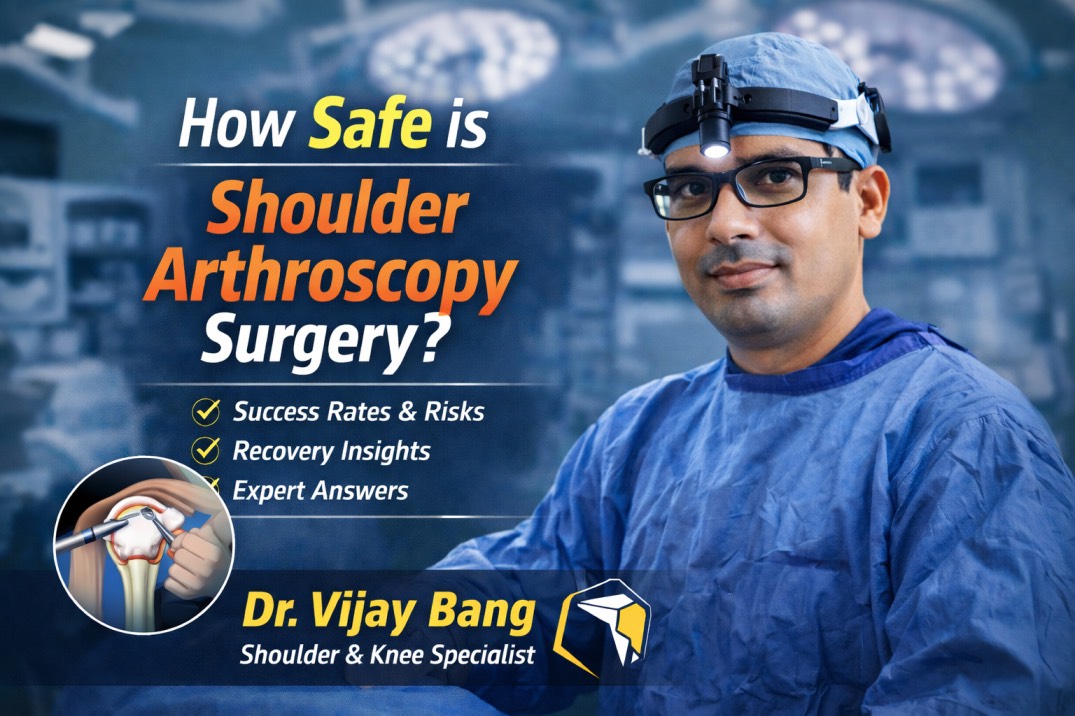
Dr Vijay Bang, among best shoulder arthroscopy surgeon in Ahmedabad speaks…
Shoulder arthroscopy is one of the most common minimally invasive orthopedic procedures performed worldwide. It is used to diagnose and treat many painful shoulder conditions — such as rotator cuff tears, labral tears, shoulder impingement, recurrent dislocation, frozen shoulder release, and biceps tendon issues.
Safety is the number one question patients ask before consenting to any surgery.
That’s why this article focuses entirely on:
- Safety of shoulder arthroscopy
- Common risks and complications
- How safe it is for different age groups
- What patients need to know before and after surgery
- Real expectations based on evidence and experience
This is written for patients considering shoulder arthroscopy, their families, and anyone searching online for clear, honest answers on safety.
1) Is shoulder arthroscopy surgery safe?
Yes, shoulder arthroscopy surgery is generally considered very safe for most patients.
It is a minimally invasive procedure — meaning small incisions, less tissue disruption, and faster healing compared with traditional open surgery. This also means lower rates of pain and lower risk of large scars.
Most patients experience significant pain relief and improved function after shoulder arthroscopy, with fewer complications than older open methods. Serious complications like infection, nerve injury, or blood clots are rare when the procedure is done by an experienced surgeon in a well-equipped hospital.
However, as with any surgery, safety also depends on proper patient selection, good planning, and careful rehabilitation. Your surgeon will assess your overall health, imaging results, and functional limitations before recommending whether shoulder arthroscopy is appropriate.
2) What are the risks of shoulder arthroscopy?
Although shoulder arthroscopy is considered safe, it still carries some risks — just like any surgical procedure.
The most common risks include:
- Infection (uncommon but possible)
- Temporary stiffness
- Persistent pain
- Bleeding or bruising
- Rare nerve irritation
Serious complications such as deep infection, permanent nerve damage, blood clots, or anesthesia-related issues are very rare in shoulder arthroscopy when performed by experienced doctors.
Your surgeon will discuss these risks with you before surgery and explain which ones are relevant to your specific condition and medical history.
3) What is the success rate of shoulder arthroscopy surgery?
Shoulder arthroscopy has a high success rate, but the exact number depends on the condition being treated.
For many common problems such as:
✔ Rotator cuff repair
✔ Labral tear repair
✔ Impingement release
✔ Loose body removal
Success rates (significant pain relief and improved function) often exceed 80% to 95% in published orthopedic literature.
Patients with early or moderate conditions tend to have better outcomes than those with severe chronic tears or advanced arthritis. Plus, patient commitment to rehabilitation and following medical advice plays a huge role in final results.
Remember, success doesn’t only mean “no pain” — it also means ability to perform daily activities, improved sleep, and functional movement.
4) Are there serious complications from shoulder arthroscopy?
Serious complications are rare, especially in minimally invasive surgery such as shoulder arthroscopy.
The major complications that can occur include:
- Deep infection (rare)
- Severe stiffness (rare but possible)
- Blood clots (very uncommon)
- Nerve injury (rare)
- Anesthesia-related issues (rare)
These are uncommon when:
✔ Surgery is done in a sterile environment
✔ Patient health issues like diabetes are controlled
✔ Surgeons follow strict protocols
Though rare, these complications require immediate medical attention if they occur. That’s why you should always be operated on by a qualified shoulder specialist, and you should follow post-operative instructions carefully.
5) Is shoulder arthroscopy less risky than open shoulder surgery?
Yes — in many cases, shoulder arthroscopy is significantly less risky than traditional open surgery.
Because:
✔ Incisions are smaller
✔ Less tissue is cut
✔ Shoulder muscles are disturbed less
✔ Hospital stays are shorter
✔ Rehabilitation begins earlier
This translates to:
👉 Less post-op pain
👉 Lower infection risk
👉 Faster return to normal activities
However, some complex conditions (large rotator cuff tears or severe joint arthritis) might still need open or hybrid approaches. Your surgeon will inform what type of procedure is safest and most effective for your condition.
6) How long does it take to recover from shoulder arthroscopy?
Recovery is often faster than patients expect, but it still needs patience and structured rehabilitation.
Typical timeline:
✔ 1–2 weeks: Pain reduces significantly, motion begins
✔ 3–6 weeks: Range of motion improves
✔ 2–3 months: Strengthening begins
✔ 3–6 months: Functional recovery for most daily activities
✔ 6–12 months: Full strength/return to sports (optional, depending on activity level)
Everyone heals differently based on age, condition, and commitment to physiotherapy. Early gentle movement (guided by a specialist physiotherapist) helps prevent stiffness.
But it’s important not to rush shoulder recovery. Healing tissues still need time to strengthen after surgery.
7) Who is not a good candidate for shoulder arthroscopy?
Most patients with shoulder joint conditions are suitable for arthroscopy, but not all.
Cases where arthroscopy may not be the best option include:
✔ Very advanced shoulder arthritis
✔ Large irreparable rotator cuff tears with poor muscle quality
✔ Severe shoulder instability requiring reconstruction
✔ Certain shoulder fractures
Your surgeon will usually recommend alternative treatments if arthroscopy is not likely to help. Alternatives may include:
► Partial shoulder replacement
► Reverse shoulder replacement
► Open repair surgery
► Non-surgical treatments
Detailed imaging (MRI/ultrasound) and clinical examination help decide correct treatment.
8) Can shoulder arthroscopy go wrong?
Like any surgery, shoulder arthroscopy can go wrong — but this is rare.
Problems that sometimes occur include:
👉 Staying stiff longer than expected
👉 Pain that takes longer to settle
👉 Minor infection
👉 Local swelling or irritation
👉 Persistent weakness
However, most of these are treatable. For example:
- Stiffness may improve with aggressive guided physiotherapy
- Minor infection can be treated with antibiotics
- Pain can be controlled with medication and rehab
That’s why early communication with your surgeon and therapist is important if symptoms persist beyond expected recovery.
9) Does shoulder arthroscopy hurt?
Initial discomfort is common after shoulder arthroscopy, but modern pain control techniques make it manageable.
Your surgeon may use:
- Nerve blocks
- Anti-inflammatory medicines
- Ice therapy
- Early active motion
Most patients describe pain as “temporary and less intense” compared to the pain they had before surgery.
Because arthroscopy is minimally invasive, pain usually decreases much faster than after traditional open surgery.
Also, early guided movement helps reduce stiffness and speed up healing.
10) How important is surgeon experience for shoulder arthroscopy safety?
Surgeon experience is one of the most critical factors in safety.
Shoulder arthroscopy is technical — it involves working in a small space with special instruments. Successful outcomes depend on:
✔ Accurate diagnosis
✔ Good surgical planning
✔ Precise execution
✔ Appropriate rehab guidance
Experienced surgeons will:
- Minimize complication risk
- Choose the safest approach
- Know how to handle unexpected findings
- Personalize recovery plans
That’s why choosing a shoulder specialist doctor with proven experience can dramatically affect both safety and outcomes.
11) How safe is shoulder arthroscopy in elderly patients?
Age itself is not a barrier to safety.
Older patients often benefit from:
✔ Reduced pain
✔ Improved function
✔ Smaller incisions
✔ Faster recovery than open surgery
However, elderly patients might have:
- Weaker bone quality
- Slower healing
- Other health conditions (like diabetes, hypertension)
These conditions increase risk slightly, but with proper evaluation and management, shoulder arthroscopy can still be very safe and effective.
The key is a thorough pre-operative assessment by your surgeon.
12) How safe is shoulder arthroscopy in athletes?
For athletes, safety includes both:
🔹 avoiding complications
🔹 restoring movement and performance
Shoulder arthroscopy is widely used for:
- Labral repairs
- Rotator cuff tears
- Impingement
- Instability
Recovery plans for athletes often include:
✔ Sport-specific exercises
✔ Strengthening phases
✔ Gradual return to play
When done well, most athletes regain functional strength and compete again without fear.
Elite athletes often undergo shoulder arthroscopy safely every year.
13) How is infection risk managed in shoulder arthroscopy?
Infection is a low but real concern. However, safe practices make it rare.
Infection prevention involves:
🔹 Sterile operating theatre
🔹 Antibiotic prophylaxis
🔹 Proper skin preparation
🔹 Short operation time
🔹 Post-op wound care
If infection does occur, early treatment with antibiotics usually resolves it without major issues.
Patients with diabetes, obesity, smoking history, or immune suppression have slightly higher infection risk — but still manageable with precautions.
14) Can shoulder arthroscopy prevent future problems?
Yes — when done for the right condition at the right time.
For example:
🔹 Rotator cuff repair prevents chronic tear enlargement
🔹 Labral repair reduces future dislocation
🔹 Impingement surgery reduces cartilage damage
However, if surgery is delayed until advanced degeneration, benefits might be limited.
Early evaluation and timely treatment improve long-term joint health.
15) When should I see a doctor after shoulder arthroscopy?
Contact your surgeon if you experience:
✔ High fever
✔ Excessive swelling
✔ Continuous severe pain despite medication
✔ Redness or discharge from incision
✔ Loss of sensation or severe weakness
Even if symptoms are mild, routine follow up is essential.
Because early detection of issues improves outcomes.
16) How does pre-surgical evaluation improve the safety of shoulder arthroscopy?
One of the biggest factors that determines how safe shoulder arthroscopy will be is proper pre-surgical planning.
Before recommending arthroscopy, a responsible shoulder specialist will:
- Take a detailed clinical history
- Perform a thorough physical examination
- Review MRI or advanced imaging
- Evaluate muscle strength and joint stability
- Assess patient’s medical conditions (diabetes, hypertension, heart disease)
Pre-operative optimization reduces complications dramatically.
For example:
- Controlling diabetes reduces infection risk
- Stopping smoking improves healing
- Adjusting blood thinners reduces bleeding risk
- Evaluating bone quality prevents fixation failure
Shoulder arthroscopy is not just about the surgery — it is about careful preparation.
When done with proper assessment, safety increases significantly.
17) Does anesthesia make shoulder arthroscopy risky?
Shoulder arthroscopy is usually performed under:
- General anesthesia
- Or combined general anesthesia with a regional nerve block
Modern anesthesia is extremely safe when administered by trained anesthesiologists.
Risks related to anesthesia are very rare and may include:
- Temporary nausea
- Sore throat
- Rare allergic reaction
- Extremely rare serious complications
Patients with heart or lung problems undergo detailed clearance before surgery.
In healthy individuals, anesthesia risk is minimal.
For most patients, the benefits of treating chronic shoulder pain outweigh the small anesthesia risks.
18) How safe is shoulder arthroscopy compared to not having surgery?
Many patients ask:
“Is it safer to avoid surgery?”
The answer depends on the condition.
For example:
- A small rotator cuff tear may enlarge if untreated
- Recurrent shoulder dislocation can damage cartilage permanently
- Chronic impingement can lead to tendon degeneration
- Labral tears in athletes may worsen with repeated activity
Avoiding surgery when it is clearly indicated can sometimes lead to:
- Progressive joint damage
- Muscle weakness
- Early arthritis
- Reduced long-term outcomes
In properly selected cases, arthroscopy is not just safe — it prevents future damage.
19) What makes shoulder arthroscopy safer today than 20 years ago?
Modern shoulder arthroscopy is far safer than older techniques because of:
- High-definition arthroscopic cameras
- Better fluid management systems
- Advanced suture anchors
- Biocompatible materials
- Improved anesthesia techniques
- Evidence-based rehabilitation protocols
Earlier, open shoulder surgery required larger incisions and longer immobilization.
Today, minimally invasive techniques reduce complications significantly.
Technology and surgical experience have made shoulder arthroscopy one of the safest orthopedic procedures.
20) Does shoulder arthroscopy cause arthritis later?
There is no evidence that properly performed shoulder arthroscopy causes arthritis.
In fact, in many cases it prevents progression by:
- Repairing torn structures
- Removing impingement
- Stabilizing unstable joints
- Correcting mechanical issues
Arthritis develops due to:
- Cartilage degeneration
- Chronic instability
- Repeated trauma
- Age-related wear
When done at the right time, arthroscopy protects the joint rather than harms it.
21) Can shoulder arthroscopy fail?
Failure is uncommon but possible.
Reasons may include:
- Severe pre-existing damage
- Poor tissue quality
- Re-injury
- Non-compliance with rehabilitation
- Delayed treatment
Failure does not always mean complication.
Sometimes recovery takes longer than expected.
Careful surgical planning and structured physiotherapy reduce failure rates significantly.
Who Should Read This Article?
This article is especially helpful for:
- Patients with rotator cuff tears
- Athletes with shoulder instability
- Individuals with recurrent shoulder dislocation
- Patients with shoulder impingement syndrome
- People considering arthroscopic shoulder surgery in Ahmedabad
- Families concerned about surgical safety
If you are searching:
- Is shoulder arthroscopy safe?
- Best shoulder arthroscopy surgeon in Ahmedabad
- Shoulder specialist doctor in Ahmedabad
- Risks of shoulder arthroscopy surgery
- Success rate of arthroscopic shoulder surgery
Then this guide was written specifically for you.
Why Select Dr Vijay Bang for Your Arthroscopic Shoulder Surgery in Ahmedabad?
When considering shoulder arthroscopy, choosing the right surgeon directly affects both safety and outcome.
Dr Vijay Bang is a Shoulder and Knee Orthopedic Surgeon in Ahmedabad with focused expertise in arthroscopic shoulder procedures.
Here’s why patients choose Dr Vijay Bang for arthroscopic shoulder surgery:
1) Specialized Shoulder Focus
Shoulder arthroscopy requires technical precision.
Dr Vijay Bang focuses extensively on shoulder conditions including:
- Rotator cuff tears
- Recurrent shoulder dislocation
- Labral injuries
- Shoulder instability
- Impingement syndrome
- Reverse shoulder replacement when required
Focused specialization improves surgical safety and outcomes.
2) Detailed Patient Evaluation
Every patient undergoes:
- Clinical examination
- Imaging review
- Functional assessment
- Medical fitness evaluation
Surgery is recommended only when clearly indicated.
This avoids unnecessary procedures and increases safety.
3) Evidence-Based Treatment Planning
Modern arthroscopy requires:
- Appropriate anchor placement
- Proper tensioning
- Precise repair technique
- Structured rehabilitation protocol
Surgical planning is customized — not standardized.
Each patient receives a treatment plan tailored to their condition and lifestyle.
4) Athlete-Friendly Approach
Young athletes with shoulder instability need:
- Stability restoration
- Full range of motion
- Safe return-to-sport guidance
Dr Vijay Bang’s structured rehabilitation guidance ensures athletes regain confidence and strength before returning to competitive activity.
5) Transparent Communication
Before surgery, patients are clearly informed about:
- Risks
- Benefits
- Recovery timeline
- Expected outcomes
- Possible complications
This transparency builds trust and improves compliance.
Safety begins with clarity.
6) Post-Surgical Follow-Up and Rehabilitation Support
Shoulder arthroscopy success depends heavily on rehabilitation.
Structured follow-up reduces:
- Stiffness
- Weakness
- Improper healing
Continuous monitoring ensures safe recovery.
Shoulder Arthroscopy in Ahmedabad – What Patients Should Know
If you are searching online for:
- Shoulder arthroscopy doctor in Ahmedabad
- Shoulder arthroscopy surgery safety
- Shoulder arthroscopy success rate in Ahmedabad
- Best shoulder specialist in Ahmedabad
You should evaluate:
✔ Surgeon specialization
✔ Experience in arthroscopic procedures
✔ Hospital infrastructure
✔ Rehabilitation support
✔ Patient communication
Ahmedabad has advanced orthopedic facilities, but surgeon expertise remains the most critical factor.
Final Conclusion – Is Shoulder Arthroscopy Safe?
Yes.
Shoulder arthroscopy is:
- Minimally invasive
- Technically advanced
- Scientifically validated
- High success rate
- Low complication rate
- Faster recovery than open surgery
However, safety depends on:
- Proper diagnosis
- Correct surgical indication
- Experienced surgeon
- Structured rehabilitation
- Patient compliance
When these factors align, shoulder arthroscopy is one of the safest and most effective orthopedic procedures available today.
If you are considering arthroscopic shoulder surgery and want clarity about safety, recovery, or outcomes, consult a qualified shoulder specialist for personalized advice.
Making an informed decision is the first step toward a pain-free and stable shoulder.