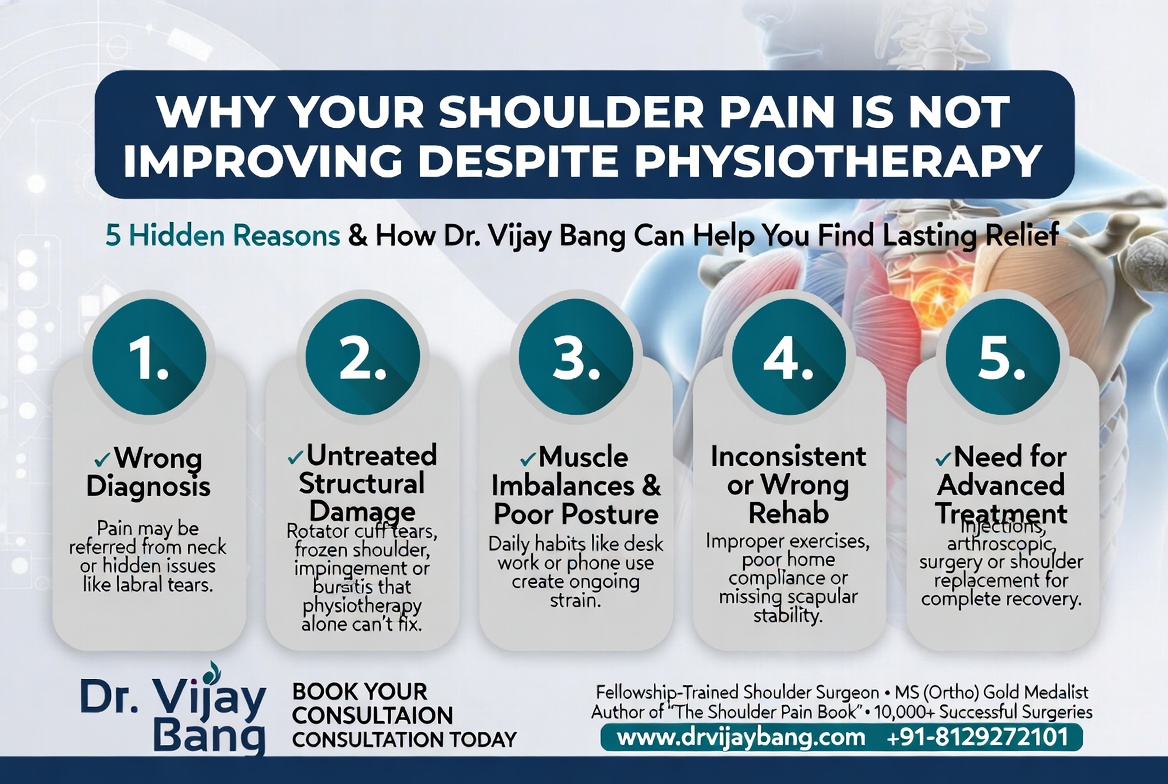
Dr Vijay Bang gives A Complete Guide by Shoulder Specialist in Ahmedabad
The Frustration Patients Don’t Talk About
You consulted a physiotherapist.
You attended sessions regularly.
You followed exercises sincerely.
And yet… the pain is still there.
If this sounds familiar, you’re not alone. One of the most common complaints I hear in my clinic in Ahmedabad is:
“Doctor, I have done physiotherapy for weeks/months… but my shoulder is not improving.”
This is not just frustrating—it’s confusing and emotionally draining.
Because physiotherapy is supposed to work.
So why is your shoulder pain not improving?
The answer is simple—but often missed:
Physiotherapy works only when the diagnosis is correct, the timing is right, and the condition is suitable for rehab alone.
In this detailed, SEO-optimized guide, we will break down every possible reason, supported by clinical insights, so you can understand what’s going wrong—and what to do next.
Who Is This Article Meant For?
This article is especially useful if you:
- Have shoulder pain lasting more than 3–4 weeks
- Have already tried physiotherapy but see little or no improvement
- Feel stiffness, weakness, or night pain
- Have been told different diagnoses by different doctors
- Want to avoid surgery but also want real results
Understanding Shoulder Pain: It’s Not Just “One Problem”
Before we go deeper, you need to understand this:
Shoulder pain is not a single disease—it’s a symptom of multiple underlying conditions.
Common causes include:
- Rotator Cuff Tear
- Frozen Shoulder
- Shoulder Impingement Syndrome
- Calcific Tendinitis
- Labral Tear
- Cervical Radiculopathy (neck-related pain)
Each of these requires a different treatment approach.
And this is where the first mistake happens.
Reason 1: Wrong Diagnosis (The #1 Cause of Failed Physiotherapy)
This is the most important and most common reason.
❌ What Usually Happens
Many patients are labeled with:
- “Muscle strain”
- “Frozen shoulder”
- “General inflammation”
Without proper evaluation.
⚠️ Reality
A patient with a Rotator Cuff Tear doing only stretching exercises meant for stiffness will worsen the tear.
Similarly, a patient with Frozen Shoulder doing strengthening exercises too early will increase pain and stiffness.
✅ What Should Be Done
- Clinical examination by a shoulder specialist
- Imaging (X-ray / MRI when required)
- Stage-wise diagnosis
Without correct diagnosis, physiotherapy becomes guesswork.
Reason 2: Treating Neck Pain as Shoulder Pain
Many patients don’t realize this:
Your shoulder pain may not be coming from your shoulder at all.
Common Condition
- Cervical Radiculopathy
Symptoms
- Pain radiating down the arm
- Tingling or numbness
- Weakness in hand or fingers
- Pain not improving with shoulder movement
Problem
Physiotherapy focused only on the shoulder will fail completely.
Solution
- Neck evaluation
- Correct physiotherapy targeting cervical spine
- Sometimes medications or injections
Reason 3: Physiotherapy Started at the Wrong Stage
Timing is everything.
Example: Frozen Shoulder
It has 3 stages:
- Freezing (painful phase)
- Frozen (stiff phase)
- Thawing (recovery phase)
❌ Mistake
Aggressive physiotherapy during the freezing stage.
Result
- Severe pain
- Muscle guarding
- Worsening stiffness
✅ Correct Approach
- Pain control first
- Gentle movements
- Gradual progression
Reason 4: Structural Damage That Cannot Heal With Exercise Alone
Some conditions require more than physiotherapy.
Example
- Large Rotator Cuff Tear
- Significant Labral Tear
Why Physiotherapy Fails Here
Because:
You cannot “exercise away” a torn tendon.
When Surgery May Be Needed
- Persistent weakness
- Loss of function
- Failure of 6–12 weeks of rehab
Reason 5: Poor Exercise Technique
Even if diagnosis is correct, execution matters.
Common Issues
- Wrong posture
- Using momentum instead of muscle control
- Overloading too early
- Skipping warm-up
Reality
Doing the right exercise the wrong way = no improvement (or worsening).
Reason 6: Inconsistent Physiotherapy
Let’s be honest.
Many patients:
- Skip sessions
- Stop exercises once pain reduces
- Do exercises irregularly
Truth
Physiotherapy is not a one-time treatment—it’s a disciplined process.
Consistency over weeks is essential.
Reason 7: Ignoring Night Pain (A Red Flag)
Night pain is not normal.
It often indicates:
- Rotator Cuff Tear
- Shoulder Impingement Syndrome
- Inflammation of bursa
If You Have This Symptom
👉 You need re-evaluation—not just continued physiotherapy.
Reason 8: Lack of Pain Control Before Rehab
Pain inhibits muscle activation.
If Pain Is High:
- Exercises become ineffective
- Muscles don’t engage properly
- Patient avoids movement
Solutions
- Medications
- Targeted injections
- Rest phase before rehab
Reason 9: Poor Posture & Lifestyle Not Corrected
You cannot fix shoulder pain in clinic and worsen it at home.
Common Causes
- Long mobile use
- Laptop posture
- Sleeping on affected side
- Driving habits
Result
Re-injury every day → no improvement
Reason 10: Expecting Quick Results
Reality Timeline
- Mild issues: 3–6 weeks
- Moderate: 6–12 weeks
- Severe: 3–6 months
Mistake
Stopping physiotherapy early because:
“It’s not working”
Reason 11: One-Size-Fits-All Physiotherapy Programs
Not all shoulders are the same.
Problem
Generic exercise sheets given to all patients.
Solution
Customized rehab protocol based on:
- Diagnosis
- Age
- Activity level
- Stage of disease
Reason 12: Missing Advanced Treatment Options
Sometimes physiotherapy alone is not enough.
Additional Options
- Ultrasound-guided injections
- PRP therapy
- Hydrodilatation (for Frozen Shoulder)
- Arthroscopic surgery
When Should You Reconsider Your Treatment?
You should consult a shoulder specialist if:
- Pain persists beyond 4–6 weeks
- Night pain is present
- Weakness is increasing
- Movement is restricted
- Physiotherapy shows no progress
Why Choose Dr Vijay Bang for Shoulder Pain Treatment?
If you are struggling with unresolved shoulder pain in Ahmedabad, choosing the right specialist makes all the difference.
What Sets Dr Vijay Bang Apart
- Dedicated shoulder specialist
- Accurate diagnosis using clinical expertise + imaging
- Stage-based treatment approach
- Focus on avoiding unnecessary surgery
- Advanced minimally invasive techniques when needed
- Personalized physiotherapy guidance
Frequently Asked Questions
1. Why is my shoulder pain not improving after physiotherapy?
Shoulder pain not improving after physiotherapy is usually a sign that the root cause of the pain has not been correctly identified or addressed. Physiotherapy is highly effective when the diagnosis is accurate, but it can fail if the underlying issue is different from what is being treated.
For example, a patient with a Rotator Cuff Tear may be doing general strengthening exercises, which can actually worsen the condition instead of healing it. Similarly, conditions like Frozen Shoulder require stage-specific treatment, and doing aggressive exercises too early can increase pain and stiffness.
Other reasons include:
- Incorrect exercise technique
- Inadequate pain control before starting rehab
- Co-existing neck problems like Cervical Radiculopathy
- Structural damage that cannot heal with exercises alone
In short, if your shoulder pain persists despite physiotherapy, it is important to re-evaluate the diagnosis and treatment plan rather than continuing the same approach.
2. How long should physiotherapy take to work for shoulder pain?
The duration for physiotherapy to show results depends on the type and severity of the shoulder condition, as well as patient compliance and overall health.
In general:
- Mild conditions (muscle strain, early impingement): 3–6 weeks
- Moderate conditions (partial tendon injury, stiffness): 6–12 weeks
- Severe conditions (chronic tears, advanced stiffness): 3–6 months or longer
However, improvement should not be judged only by pain reduction. Early signs that physiotherapy is working include:
- Gradual improvement in range of motion
- Better strength and control
- Reduced night pain
- Improved ability to perform daily activities
If there is no noticeable improvement after 4–6 weeks, it is advisable to consult a specialist to rule out conditions like Labral Tear or significant tendon injury.
3. Can physiotherapy worsen shoulder pain?
Yes, physiotherapy can worsen shoulder pain if it is done incorrectly, started at the wrong stage, or based on an incorrect diagnosis.
For instance:
- In Frozen Shoulder, aggressive stretching during the painful “freezing stage” can significantly increase inflammation and pain.
- In Rotator Cuff Tear, heavy strengthening exercises can worsen the tear.
Other factors that may worsen pain include:
- Poor exercise technique
- Overtraining without adequate rest
- Ignoring pain signals and pushing through discomfort
- Lack of proper supervision
A mild increase in soreness is normal during rehabilitation, but persistent or worsening pain is a warning sign that your treatment approach needs modification.
4. When should I stop physiotherapy if it’s not working?
You should not abruptly stop physiotherapy, but you should definitely reassess your treatment plan if there is no improvement after a reasonable period.
Consider consulting a shoulder specialist if:
- Pain persists beyond 4–6 weeks
- There is no improvement in movement or strength
- Pain is worsening despite regular sessions
- Night pain continues to disturb sleep
Continuing ineffective physiotherapy can delay proper treatment and may even worsen conditions like Shoulder Impingement Syndrome.
The best approach is not to stop completely, but to modify the treatment based on a fresh clinical evaluation and, if needed, imaging studies.
5. Do all rotator cuff tears need surgery?
No, not all Rotator Cuff Tear cases require surgery. The treatment depends on the size of the tear, patient age, activity level, and symptoms.
Non-surgical treatment may work if:
- The tear is small or partial
- Pain is manageable
- Shoulder function is relatively preserved
- The patient is not highly physically demanding
Surgery may be recommended if:
- There is a large or full-thickness tear
- Persistent weakness is present
- Pain does not improve after 6–12 weeks of physiotherapy
- There is significant loss of function
Early diagnosis is crucial because delayed treatment of large tears can lead to irreversible muscle damage, making surgery less effective.
6. Is MRI necessary for shoulder pain diagnosis?
MRI is not required for every patient with shoulder pain, but it becomes very important in certain situations where clinical examination alone is not sufficient.
An MRI is usually recommended when:
- Pain persists despite 4–6 weeks of treatment
- There is suspicion of a Labral Tear or tendon rupture
- Weakness is significant
- Night pain is severe
- Surgery is being considered
MRI helps in:
- Detecting soft tissue injuries
- Assessing tendon quality
- Identifying inflammation or structural damage
However, it should always be interpreted in correlation with clinical findings, as not all MRI abnormalities require treatment.
7. What is the fastest way to recover from shoulder pain?
The fastest way to recover from shoulder pain is not by rushing treatment, but by following the correct, evidence-based approach from the beginning.
Key steps include:
- Accurate diagnosis by a shoulder specialist
- Stage-appropriate treatment plan
- Proper pain management (if needed)
- Guided physiotherapy with correct technique
- Consistency and discipline in exercises
- Correction of posture and daily habits
Trying random exercises from the internet or continuing ineffective physiotherapy can delay recovery.
Final Takeaway
If your shoulder pain is not improving despite physiotherapy, don’t just continue blindly.
Pain is a signal—not something to ignore.
The key lies in:
- Correct diagnosis
- Proper timing
- Personalized treatment
Conclusion
Physiotherapy is powerful—but only when used correctly.
If it’s not working, the problem is not always the therapy—it’s the approach.
Understanding the why behind failure is the first step toward real recovery.
About the Author
Dr Vijay Bang
Shoulder and Knee Orthopedic Surgeon in Ahmedabad
www.drvijaybang.com
Call/whatsapp – +91 8129272101
(share your report on WhatsApp for trustable honest opinion)
Stay Connected with Dr. Vijay Bang for Regular Health Tips:
Instagram: https://www.instagram.com/drvijaybangortho
YouTube: https://www.youtube.com/@drvijaybangortho
Facebook: https://www.facebook.com/drvijaybangortho
Linkedin: https://www.linkedin.com/in/drvijaybangortho/
Keywords
shoulder pain not improving
physiotherapy not working shoulder
rotator cuff tear treatment
frozen shoulder recovery time
shoulder pain causes
shoulder specialist Ahmedabad
shoulder pain after physiotherapy
why shoulder pain persists