Partial Knee Replacement– The Question Every Knee Patient Asks
If you are suffering from chronic knee pain, difficulty walking, or stiffness due to arthritis, you’ve likely searched:
- “What is partial knee replacement?”
- “Is partial knee replacement better than total knee replacement?”
- “Can I avoid full knee replacement?”
And most importantly:
“Am I the right candidate for partial knee replacement?”
The problem is—most information online is either:
- Too technical
- Too generic
- Or not focused on real patient decision-making
Who Should Read This Guide?
This guide is for:
- Patients diagnosed with Knee Osteoarthritis
- Individuals considering knee replacement surgery
- People who want to avoid total knee replacement
- Patients with one-sided knee pain
- Anyone searching for partial knee replacement recovery, cost, success rate, or alternatives
SECTION 1: BASICS OF PARTIAL KNEE REPLACEMENT
Q1. What is partial knee replacement surgery in simple terms?
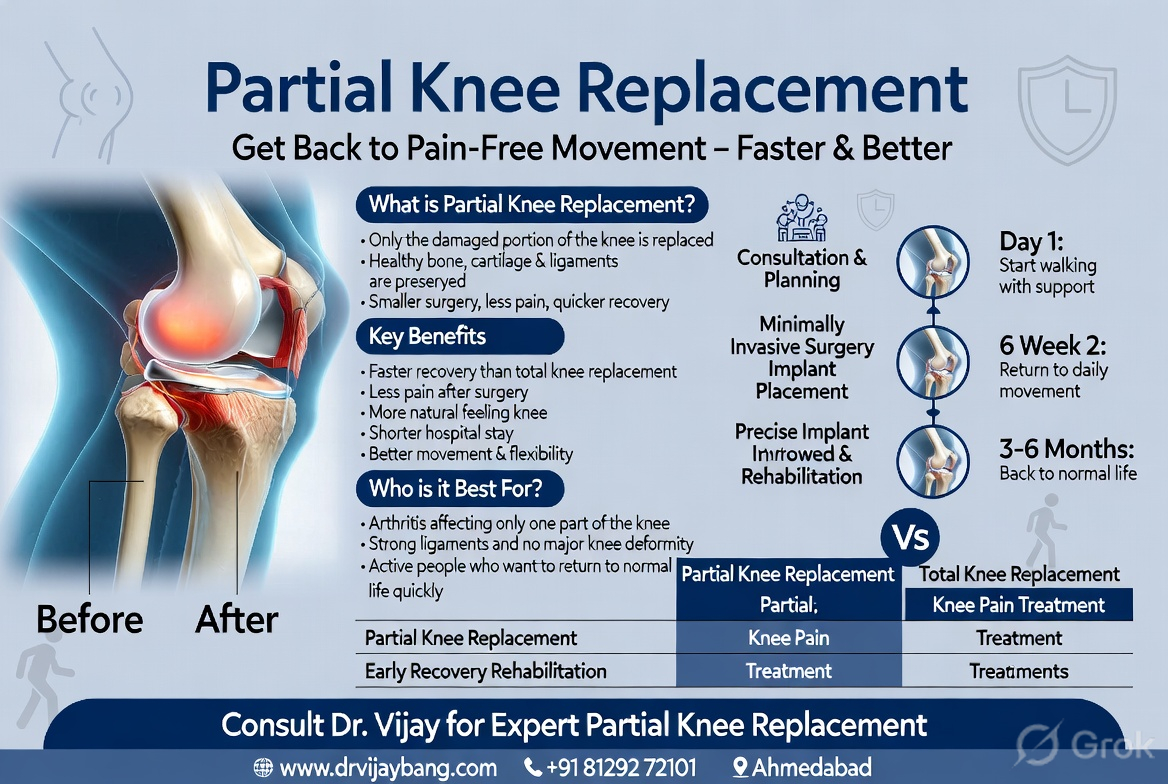
Partial knee replacement, also known as unicompartmental knee replacement, is a surgical procedure where only the damaged portion of the knee joint is replaced with an artificial implant, while the healthy cartilage, bone, and ligaments are preserved.
Unlike total knee replacement, which replaces the entire joint, partial knee replacement focuses on targeted treatment of localized damage, making it a more conservative and natural approach.
This is why many patients prefer it when suitable—it allows:
- Better knee function
- Faster recovery
- More natural movement
Q2. What does “unicompartmental knee replacement” mean?
The knee joint is divided into three compartments:
- Medial (inner side)
- Lateral (outer side)
- Patellofemoral (front portion under kneecap)
“Unicompartmental” means that only one compartment is affected and treated surgically.
This is a key concept in deciding whether partial knee replacement is possible.
Q3. Why is partial knee replacement becoming more popular in India?
Partial knee replacement is gaining popularity in cities like Ahmedabad because:
- Earlier diagnosis of arthritis
- Increased awareness among patients
- Demand for faster recovery
- Desire to maintain natural knee movement
Patients today are more informed and prefer less invasive, joint-preserving options whenever possible.
Q4. Is partial knee replacement a new or experimental procedure?
No.
Partial knee replacement has been performed for decades. However, advancements in surgical techniques, implant design, and imaging have significantly improved outcomes in recent years.
Today, when performed in the right patient by an experienced surgeon, it offers excellent long-term results.
SECTION 2: WHO NEEDS PARTIAL KNEE REPLACEMENT?
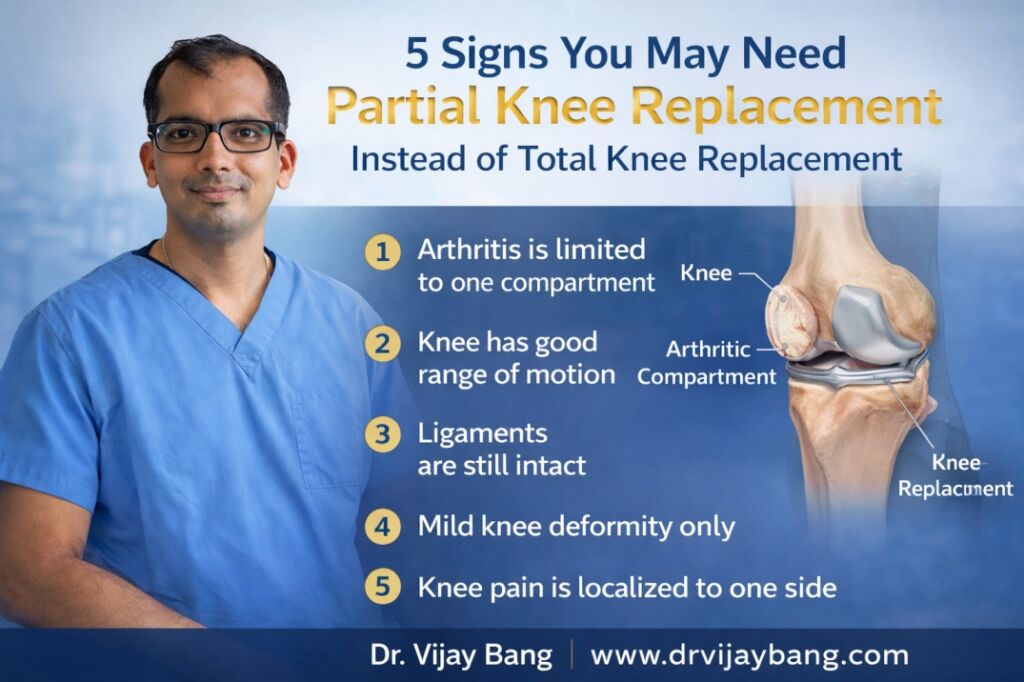
Q5. Who is the ideal candidate for partial knee replacement?
You may be an ideal candidate if:
- Your knee pain is localized to one side (usually inner side)
- You have early to moderate Knee Osteoarthritis
- Your knee ligaments (especially ACL) are intact
- Your knee has good range of motion
- You do not have severe deformity
This type of patient benefits most because the healthy parts of the knee can be preserved.
Q6. What symptoms indicate I may need partial knee replacement?
Common symptoms include:
- Pain on one side of the knee
- Difficulty walking or climbing stairs
- Pain worsening with activity
- Relief with rest
- Stiffness but not complete loss of movement
If these symptoms persist despite medications and physiotherapy, surgical options may be considered.
Q7. Can partial knee replacement be done for advanced arthritis?
Generally, no.
If arthritis involves multiple compartments, then total knee replacement is more appropriate.
Partial knee replacement is specifically designed for localized damage, not widespread degeneration.
Q8. Can young patients undergo partial knee replacement?
Yes, and in fact, younger patients often benefit more.
Because:
- It preserves natural knee structures
- Allows higher activity levels
- Can be converted to total knee replacement later if needed
Q9. Who should NOT undergo partial knee replacement?
You may not be suitable if:
- Arthritis is present in more than one compartment
- You have severe knee deformity (bow legs or knock knees)
- Ligaments are unstable
- You have inflammatory arthritis
- You have significant stiffness
Proper patient selection is the most critical factor in success.
SECTION 3: PARTIAL VS TOTAL KNEE REPLACEMENT
Q10. What is the difference between partial and total knee replacement?
Partial knee replacement:
- Replaces only damaged portion
- Preserves ligaments and healthy cartilage
- Feels more natural
Total knee replacement:
- Replaces entire joint
- Removes more bone
- More suitable for advanced arthritis
Q11. Which is better: partial knee replacement or total knee replacement?
Neither is universally better.
The best surgery is the one that is appropriate for your condition.
Partial knee replacement is better when:
- Arthritis is limited
- Knee stability is preserved
Total knee replacement is better when:
- Damage is widespread
- Knee is severely deformed
Q12. Does partial knee replacement feel more natural?
Yes.
Because:
- Cruciate ligaments are preserved
- Normal knee mechanics are maintained
Patients often report:
- Better balance
- More normal walking pattern
SECTION 4: SURGERY DETAILS
Q13. How is partial knee replacement surgery performed step-by-step?
The procedure involves:
- Small incision over knee
- Removal of damaged cartilage and bone
- Preparation of bone surfaces
- Placement of artificial implant
- Preservation of healthy structures
The goal is precision and minimal damage.
Q14. How long does partial knee replacement surgery take?
Typically:
- 45 minutes to 90 minutes
Shorter than total knee replacement.
Q15. Is partial knee replacement minimally invasive?
Yes.
Advantages include:
- Smaller incision
- Less blood loss
- Faster recovery
SECTION 5: BENEFITS OF PARTIAL KNEE REPLACEMENT
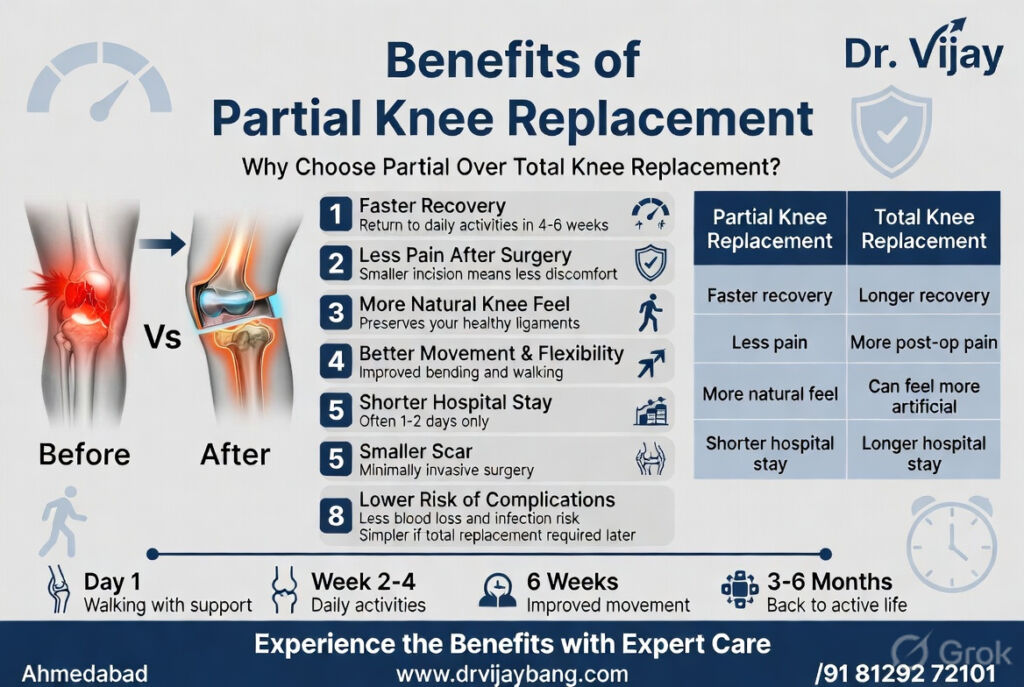
Q16. What are the major benefits of partial knee replacement?
- Faster recovery
- Less postoperative pain
- Shorter hospital stay
- Better range of motion
- More natural knee feel
Q17. How soon can I walk after partial knee replacement?
Most patients:
- Start walking within 24–48 hours
Early mobilization is a major advantage.
SECTION 6: RECOVERY & REHABILITATION
Q18. What is the recovery timeline for partial knee replacement?
- Walking: 1–2 days
- Daily activities: 3–6 weeks
- Full recovery: 2–3 months
Q19. Is physiotherapy necessary after partial knee replacement?
Yes.
Physiotherapy is essential for:
- Strengthening muscles
- Improving flexibility
- Achieving full recovery
Q20. When can I resume normal activities?
- Office work: 2–3 weeks
- Driving: 3–4 weeks
- Active lifestyle: 6–8 weeks
SECTION 7: RISKS & COMPLICATIONS
Q21. What are the risks of partial knee replacement?
- Infection
- Blood clots
- Implant wear
- Need for revision surgery
Q22. Is partial knee replacement safe?
Yes, when performed by an experienced surgeon, it is very safe and effective.
SECTION 8: LONG-TERM OUTCOMES
Q23. How long does partial knee replacement last?
Typically:
- 10–15 years or more
Depends on:
- Activity level
- Weight
- Lifestyle
Q24. Can partial knee replacement fail?
Yes, but rare with proper selection.
Reasons include:
- Arthritis progression
- Implant loosening
Q25. Can it be converted to total knee replacement later?
Yes.
This is one of its biggest advantages.
SECTION 9: COST & PRACTICAL QUESTIONS
Q26. What is the cost of partial knee replacement in India?
Cost varies depending on:
- Hospital
- Implant type
- Surgeon expertise
Q27. Is it covered by insurance?
Yes, most insurance policies cover it.
SECTION 10: WHY CHOOSE DR VIJAY BANG?
If you are considering knee surgery in Ahmedabad, choosing the right specialist is critical.
What Makes This Approach Unique
- Accurate diagnosis and patient selection
- Focus on joint preservation
- Advanced surgical techniques
- Personalized rehabilitation
The goal is not just surgery—it is restoring your natural movement and quality of life.
FINAL TAKEAWAY
Partial knee replacement is the best option for the right patient—not for everyone.
It offers:
- Faster recovery
- Natural knee function
- Long-term relief
CONCLUSION
If you are dealing with knee pain:
👉 Don’t rush into total knee replacement
👉 Don’t delay necessary treatment
Ask the right question: “Am I suitable for partial knee replacement?”
That one question can change your outcome completely.
About the Author
Dr Vijay Bang
Shoulder and Knee Orthopedic Surgeon in Ahmedabad
www.drvijaybang.com
Call/whatsapp – +91 8129272101
(share your report on WhatsApp for trustable honest opinion)
Stay Connected with Dr. Vijay Bang for Regular Health Tips:
Instagram: https://www.instagram.com/drvijaybangortho
YouTube: https://www.youtube.com/@drvijaybangortho
Facebook: https://www.facebook.com/drvijaybangortho
Linkedin: https://www.linkedin.com/in/drvijaybangortho/