Shoulder replacement surgery has evolved significantly over the past decade. What was once considered a complex, highly technique-dependent procedure is now entering an era of precision, predictability, and personalization—thanks to robotic-assisted surgery combined with advanced pre-operative planning.
If you are suffering from severe shoulder pain due to arthritis or complex joint damage, understanding this technology can help make a more informed decision.
Who Is This Article For?
This guide is designed for:
- Patients suffering from advanced shoulder arthritis
- Individuals advised for shoulder replacement surgery
- Patients not improving with conservative treatment
- Medical professionals looking to understand evolving surgical technologies
- Anyone wanting better outcomes with minimal complications
What Is Shoulder Replacement Surgery?
Shoulder replacement (also called arthroplasty) involves replacing damaged parts of the shoulder joint with artificial implants.
The shoulder joint consists of:
- Humeral head (ball)
- Glenoid (socket)
In arthritis, the smooth cartilage covering these surfaces wears out, leading to:
- Pain
- Stiffness
- Grinding sensation
- Loss of movement
Types of Shoulder Replacement
1. Anatomic Shoulder Replacement
- Mimics natural anatomy
- Used when rotator cuff is intact
2. Reverse Shoulder Replacement
- Ball and socket positions are reversed
- Used in:
- Massive rotator cuff tears
- Complex arthritis cases
Limitations of Traditional Shoulder Replacement
Even with experienced surgeons, traditional surgery has challenges:
❌ Implant positioning depends on surgeon’s estimation
❌ Variation in anatomy makes accuracy difficult
❌ Malposition can lead to:
- Early implant loosening
- Reduced movement
- Persistent pain
- Need for revision surgery
👉 This is where robotic-assisted surgery with pre-planning changes the game.
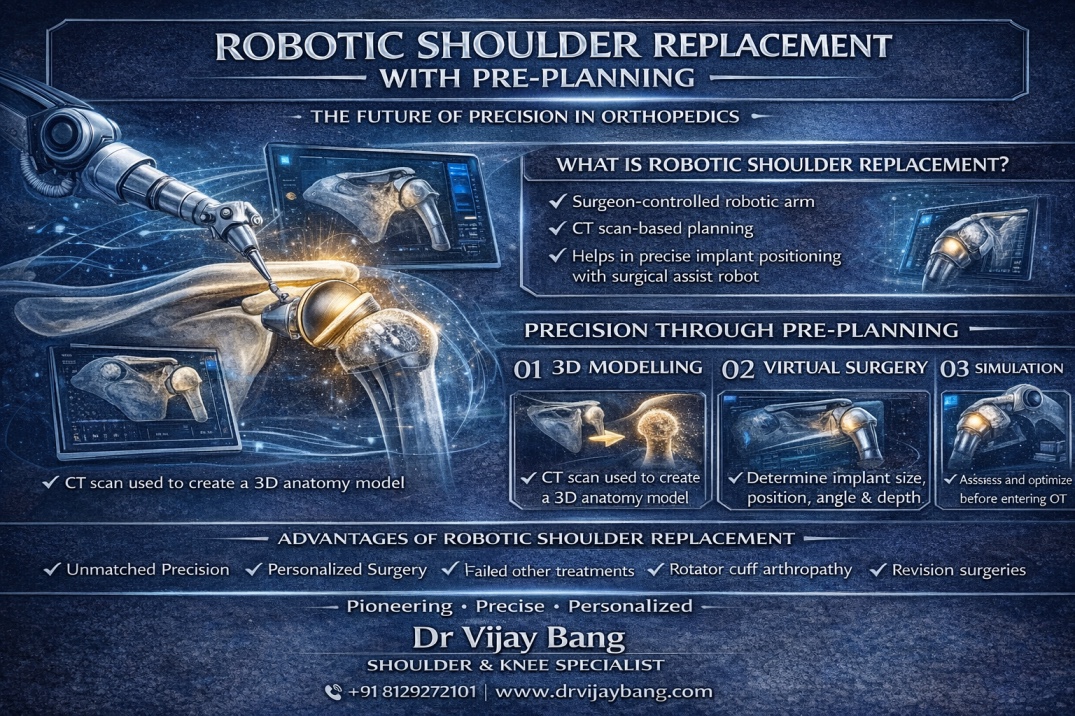
What Is Robotic Shoulder Replacement?
Robotic shoulder replacement is not a robot doing surgery independently.
👉 It is a highly advanced tool controlled by the surgeon that enhances:
- Precision
- Accuracy
- Safety
The robot assists in implant positioning based on pre-operative planning, ensuring near-perfect execution.
What Is Pre-Planning in Robotic Surgery?
Pre-planning is the most important step in robotic surgery.
Step 1: CT Scan-Based 3D Modeling
- A detailed CT scan of the shoulder is taken
- A 3D model of the patient’s anatomy is created
Step 2: Virtual Surgery Before Actual Surgery
- Surgeon plans:
- Implant size
- Implant position
- Angle and depth
- Adjustments are made before entering the OT
Step 3: Simulation of Outcomes
- Range of motion can be predicted
- Stability and alignment can be optimized
👉 This means the surgery is already “performed virtually” before the actual procedure.
How Does the Robot Help During Surgery?
During surgery, the robotic system:
✔ Guides bone preparation
✔ Ensures exact implant placement
✔ Maintains planned angles and depth
✔ Prevents deviation from plan
👉 Think of it as a GPS navigation system for the surgeon.
Key Advantages of Robotic Shoulder Replacement
1. Unmatched Precision
- Implant positioning is highly accurate
- Reduces human error
2. Personalized Surgery
- Every patient has unique anatomy
- Surgery is customized to that anatomy
3. Better Implant Longevity
- Proper alignment reduces wear and tear
- Implants last longer
4. Improved Range of Motion
- Accurate positioning = better biomechanics
5. Reduced Complications
- Lower risk of:
- Loosening
- Dislocation
- Early failure
6. Predictable Outcomes
- Surgery outcome becomes more reliable
Who Should Consider Robotic Shoulder Replacement?
Ideal candidates include:
- Advanced shoulder arthritis
- Failed conservative treatment
- Rotator cuff arthropathy
- Complex deformities
- Revision shoulder surgeries
When Is Robotic Surgery Especially Beneficial?
👉 In cases where:
- Bone deformity is severe
- Anatomy is distorted
- Previous surgery has failed
- High precision is critical
Is Robotic Surgery Safe?
Yes—when performed by a trained surgeon.
Important points:
- Robot does NOT replace surgeon
- Surgeon remains in full control
- Technology enhances accuracy, not decision-making
Common Myths About Robotic Surgery
❌ “Robot does the surgery”
👉 False — surgeon controls everything
❌ “It is risky”
👉 Actually safer due to precision
❌ “It is only for complex cases”
👉 Useful in both routine and complex surgeries
Pre-Operative Preparation
Before surgery, patients undergo:
- Clinical evaluation
- Imaging (X-ray, CT scan)
- Medical fitness check
- Discussion of expectations
What Happens on the Day of Surgery?
- Procedure is done under anesthesia
- Small incisions are made
- Robot assists in bone preparation
- Implants are placed as per pre-plan
Recovery After Robotic Shoulder Replacement
Recovery is similar or slightly better than traditional surgery:
Early Phase (0–4 weeks)
- Pain control
- Gentle movements
Mid Phase (4–12 weeks)
- Physiotherapy
- Gradual increase in motion
Late Phase (3–6 months)
- Strengthening
- Return to daily activities
Expected Outcomes
Most patients experience:
✔ Significant pain relief
✔ Improved shoulder movement
✔ Better quality of life
Are There Any Limitations?
- Availability in select centers
- Cost may be slightly higher
- Requires experienced surgeon
Cost Considerations
Robotic surgery may cost more due to:
- Advanced technology
- Pre-operative planning systems
👉 But it may reduce long-term costs by:
- Decreasing complications
- Increasing implant life
Why Choosing the Right Surgeon Still Matters
Even with robotics:
👉 Surgeon expertise is critical
👉 Decision-making is human-driven
👉 Technology is only as good as the user
Future of Shoulder Replacement
The future is heading toward:
- AI-assisted planning
- Fully personalized implants
- Faster recovery protocols
- Better long-term outcomes
Why Early Decision Matters
Delaying surgery in severe arthritis can lead to:
- Bone loss
- Muscle damage
- Poor surgical outcomes
👉 Early intervention gives better results.
Final Takeaway
Robotic shoulder replacement with pre-planning is not just a technological upgrade—it is a paradigm shift in orthopedic surgery.
👉 It brings together:
- Precision
- Personalization
- Predictability
For patients, this means:
- Better outcomes
- Faster recovery
- Longer-lasting results
About the Author
Dr Vijay Bang
Shoulder and Knee Orthopedic Surgeon in Ahmedabad
www.drvijaybang.com
Call/whatsapp – +91 8129272101
(share your report on WhatsApp for trustable honest opinion)
Stay Connected with Dr. Vijay Bang for Regular Health Tips:
Instagram: https://www.instagram.com/drvijaybangortho
YouTube: https://www.youtube.com/@drvijaybangortho
Facebook: https://www.facebook.com/drvijaybangortho
Linkedin: https://www.linkedin.com/in/drvijaybangortho/
Keywords
robotic shoulder replacement, robotic shoulder surgery India, shoulder replacement surgery Ahmedabad, reverse shoulder replacement, shoulder arthritis treatment, CT based pre planning shoulder surgery, best shoulder surgeon Ahmedabad