Shoulder pain is one of the most common musculoskeletal complaints seen in clinical practice. While many patients ignore mild or intermittent discomfort, some of these cases are actually due to a rim rent tear—an early form of rotator cuff injury that, if left untreated, can progress into a more serious condition.
Understanding this condition is crucial because:
👉 A small, early tear can often be treated without surgery—if diagnosed on time.
What is a Rim Rent Tear?
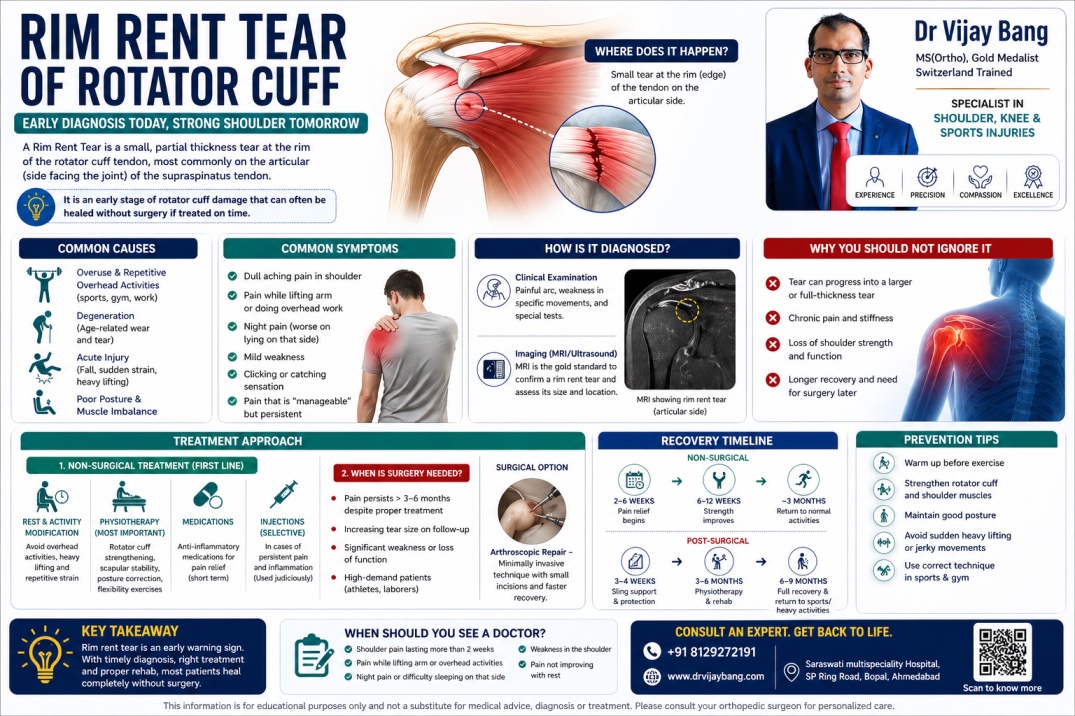
A rim rent tear is a partial thickness tear of the rotator cuff tendon, typically occurring at the articular (joint) side of the tendon, where it attaches to the bone.
Most commonly, it involves the:
- supraspinatus tendon
This area is particularly vulnerable due to:
- Reduced blood supply
- High mechanical stress
Understanding the Rotator Cuff
The rotator cuff is made up of four muscles:
- Supraspinatus
- Infraspinatus
- Teres minor
- Subscapularis
These muscles:
- Stabilize the shoulder joint
- Allow lifting and rotation movements
👉 A rim rent tear usually represents the earliest stage of rotator cuff damage.
Why is it Called “Rim Rent”?
The term “rim rent” comes from:
- The edge (rim) of the tendon near its attachment
- A small rent (tear) in that region
It is essentially a fraying or small defect at the tendon insertion.
Causes of Rim Rent Tear
🔹 1. Degenerative Changes (Most Common)
- Age-related wear and tear
- Reduced vascularity
- Tendon weakening over time
🔹 2. Repetitive Overuse
- Overhead activities
- Gym exercises (bench press, shoulder press)
- Sports like cricket, badminton
🔹 3. Shoulder Impingement
- Narrow space in shoulder joint
- Tendon gets compressed repeatedly
🔹 4. Acute Injury
- Fall on outstretched hand
- Sudden lifting of heavy weight
🔹 5. Poor Biomechanics
- Muscle imbalance
- Poor posture
- Weak scapular control
Symptoms of Rim Rent Tear
One of the biggest challenges is that symptoms are often mild in early stages, leading to delayed diagnosis.
⚠️ Common Symptoms:
- Dull, aching shoulder pain
- Pain while lifting the arm
- Difficulty in overhead activities
- Night pain (especially lying on affected side)
- Mild weakness
- Clicking or catching sensation
👉 Many patients describe:
“Pain is there, but I can still manage.”
This is exactly the stage where intervention is most effective.
Why You Should Not Ignore It
Ignoring a rim rent tear can lead to:
❌ Progression into a full-thickness tear
❌ Chronic shoulder pain
❌ Loss of strength
❌ Shoulder stiffness (frozen shoulder)
❌ Need for surgery later
👉 Early treatment can prevent all of these complications.
How is Rim Rent Tear Diagnosed?
🩺 1. Clinical Examination
- Painful arc
- Weakness in abduction
- Specific rotator cuff tests
🧠 2. Imaging
✔ MRI (Gold Standard)
- Detects partial tears
- Shows location and severity
✔ Ultrasound
- Useful screening tool
Types of Partial Rotator Cuff Tears
Rim rent tears fall under partial thickness tears, which can be:
- Articular-sided (most common)
- Bursal-sided
- Intrasubstance
👉 Rim rent is typically articular-sided tear of supraspinatus tendon.
Treatment of Rim Rent Tear
✅ 1. Non-Surgical Treatment (First Line)**
Most rim rent tears can be treated conservatively.
✔ Rest & Activity Modification
Avoid:
- Overhead activities
- Heavy lifting
- Repetitive strain
✔ Physiotherapy (Most Important Component)
Focus on:
- Rotator cuff strengthening
- Scapular stabilization
- Postural correction
- Range of motion exercises
👉 This is the cornerstone of treatment.
✔ Medications
- Short-term pain relief
- Anti-inflammatory drugs
✔ Injections (Selective Use)
- Used in persistent pain
- Should not be overused
❗ 2. When is Surgery Required?
Surgery is considered if:
- Pain persists >3–6 months
- Tear increases in size
- Significant functional limitation
- High-demand individuals (athletes, laborers)
🔬 Surgical Options
✔ Arthroscopic Repair
- Minimally invasive
- Small incisions
- Faster recovery
Recovery Timeline
🕒 Non-Surgical:
- Pain relief: 2–6 weeks
- Strength recovery: 6–12 weeks
- Full recovery: ~3 months
🕒 Surgical:
- Sling: 3–4 weeks
- Rehab: 3–6 months
- Full recovery: 6–9 months
Prevention of Rim Rent Tear
✔ Warm-up before exercise
✔ Avoid sudden heavy lifting
✔ Maintain proper posture
✔ Strengthen shoulder muscles
✔ Correct gym technique
Who is at Risk?
- Age > 35–40 years
- Sedentary lifestyle
- Gym-goers with improper technique
- Athletes (overhead sports)
- Desk job professionals (poor posture)
Rim Rent Tear vs Full Rotator Cuff Tear
| Feature | Rim Rent Tear | Full Tear |
|---|---|---|
| Severity | Mild | Severe |
| Thickness | Partial | Full |
| Treatment | Mostly non-surgical | Often surgical |
| Recovery | Faster | Longer |
Key Takeaway
👉 Rim rent tear is an early warning sign
- Small tear today
- Big problem tomorrow (if ignored)
👉 But if treated early:
- No surgery needed
- Full recovery possible
When Should You See a Doctor?
- Shoulder pain >2 weeks
- Night pain
- Difficulty lifting arm
- Pain not improving with rest
Conclusion
A rim rent tear is not a serious condition—if managed at the right time.
The real problem is delay in diagnosis and treatment.
👉 Early intervention can:
- Prevent tear progression
- Restore normal function
- Avoid surgery
👉 Remember:
“Small tear = Big opportunity to heal without surgery.”
About the Author
Dr Vijay Bang
Shoulder and Knee Orthopedic Surgeon in Ahmedabad
www.drvijaybang.com
Call/whatsapp – +91 8129272101
(share your report on WhatsApp for trustable honest opinion)
Stay Connected with Dr. Vijay Bang for Regular Health Tips:
Instagram: https://www.instagram.com/drvijaybangortho
YouTube: https://www.youtube.com/@drvijaybangortho
Facebook: https://www.facebook.com/drvijaybangortho
Linkedin: https://www.linkedin.com/in/drvijaybangortho/
Keywords
Rim rent tear, rotator cuff tear, supraspinatus tear, shoulder pain treatment, partial rotator cuff tear, shoulder injury, physiotherapy shoulder, arthroscopic shoulder surgery, shoulder pain causes, orthopedic doctor Ahmedabad