A Complete, Patient-Friendly Guide to Help You Make the Right Decision
Introduction
If you’ve been diagnosed with a Rotator Cuff Tear, one of the most common questions is:
👉 “Can I delay surgery?”
This is a very natural concern. Many patients prefer to avoid or postpone surgery due to fear, work commitments, or the hope that the pain will settle with medicines or physiotherapy.
But here’s the reality you need to clearly understand:
👉 Not all rotator cuff tears behave the same.
👉 And delaying surgery can sometimes convert a simple problem into a complex, irreversible one.
This article is written to give you a clear, honest, and complete understanding of:
- When delaying surgery may be acceptable
- When it becomes risky
- What actually happens inside your shoulder over time
- And why timely surgery often gives the best long-term results
Understanding Rotator Cuff Tear
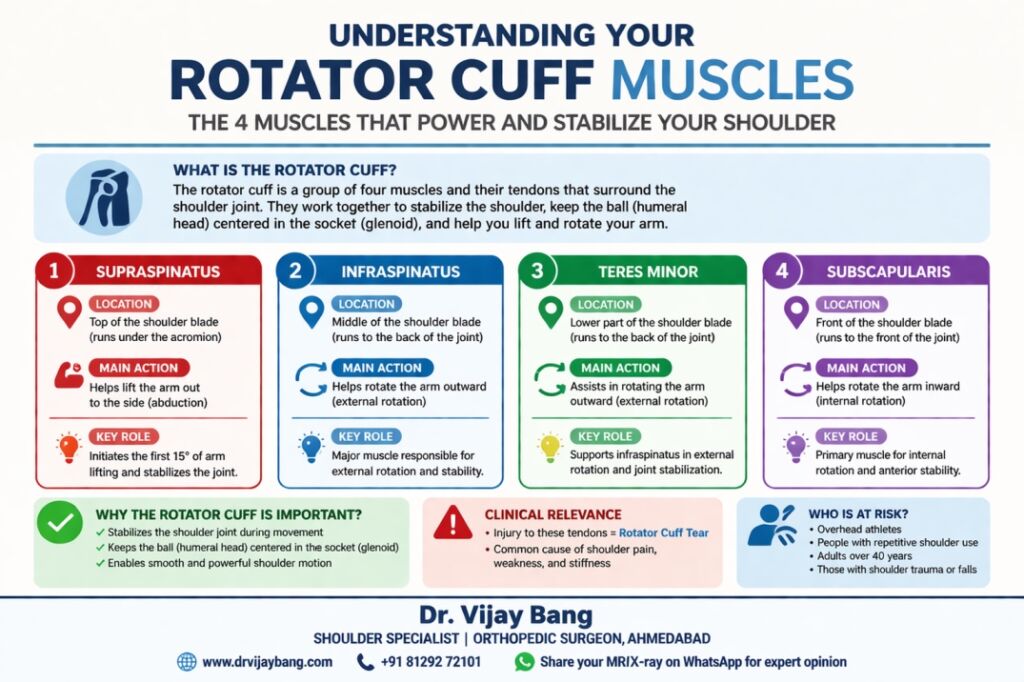
Your shoulder works smoothly because of a group of muscles called the rotator cuff.
These muscles:
- Help lift your arm
- Stabilize the shoulder
- Allow overhead movements
When one or more tendons tear:
- Movement becomes painful
- Strength reduces
- Daily activities get affected
Types of Rotator Cuff Tears
Understanding your tear type is critical before deciding to delay.
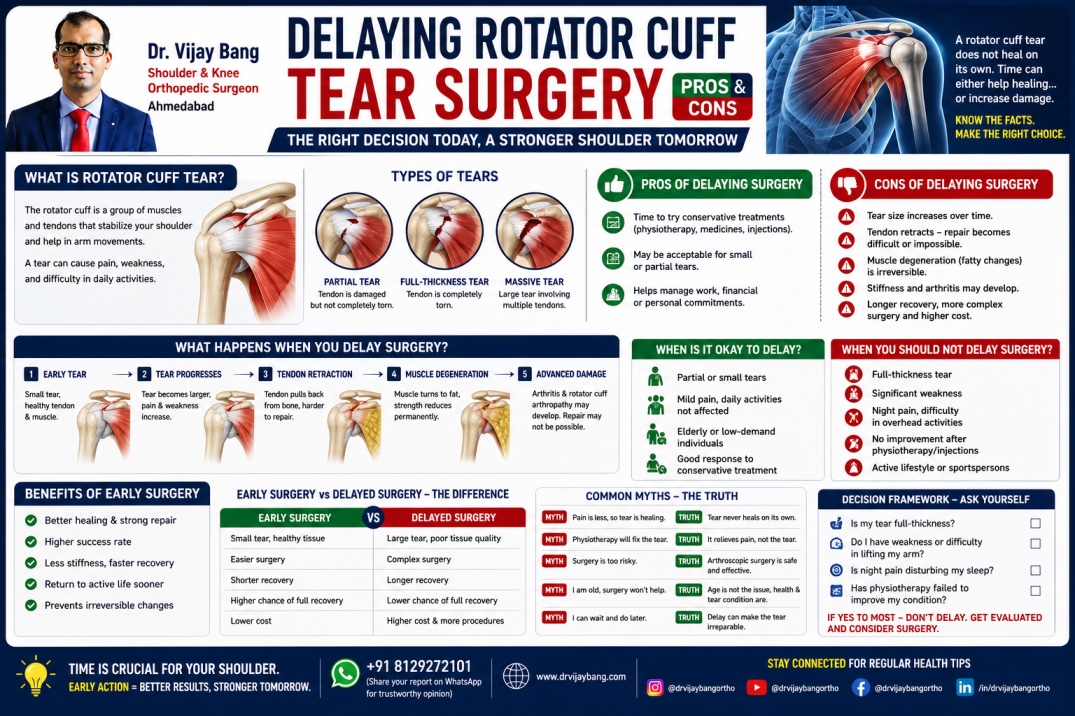
1. Partial Tear
- Tendon is damaged but not completely torn
- Often managed initially without surgery
2. Full-Thickness Tear
- Tendon is completely torn
- Usually requires surgical repair
3. Massive Tear
- Large tear involving multiple tendons
- More complex to treat
👉 The larger the tear, the more risky it is to delay surgery.

Why Patients Want to Delay Surgery
Let’s be practical—these are the most common reasons:
- Fear of surgery
- Financial concerns
- Work or family responsibilities
- Belief that pain will improve with time
- Temporary relief with medicines or injections
👉 All of these are understandable.
But the decision should be based on medical facts, not temporary comfort.
What Happens If You Delay Surgery? (Inside the Shoulder)
This is the most important section.
When a rotator cuff tear is left untreated:
1. Tear Size Increases
The tendon does NOT heal on its own.
Instead:
- Small tear → becomes larger
- Repair becomes more difficult
2. Tendon Retraction Occurs
Over time, the torn tendon:
- Pulls away from its original attachment
- Becomes difficult to bring back surgically
👉 In late stages, repair may not even be possible.
3. Muscle Degeneration (Fatty Changes)
This is irreversible.
- Healthy muscle → turns into fat
- Muscle loses function permanently
👉 Even surgery cannot fully restore strength at this stage.
4. Shoulder Stiffness Develops
Delayed treatment often leads to:
- Frozen shoulder
- Severe restriction of movement
5. Arthritis May Develop
Long-standing tears can lead to:
- Rotator cuff arthropathy
- Joint damage
👉 This may require joint replacement instead of simple repair.
Pros of Delaying Surgery (Yes, There Are Some)
Let’s be fair and balanced.
1. Time to Try Conservative Treatment
For some patients:
- Physiotherapy
- Medicines
- Injections
can reduce symptoms temporarily.
2. Suitable for Small or Partial Tears
In selected cases:
- Surgery may not be immediately required
3. Helps Manage Practical Constraints
- Work commitments
- Financial planning
👉 BUT here’s the critical point:
These “pros” are mostly short-term benefits.
The long-term risks can outweigh them significantly.
Cons of Delaying Surgery (The Real Risks)
1. Reduced Chances of Successful Repair
Early surgery:
- Tendon is healthy
- Repair is easier
Delayed surgery:
- Poor tissue quality
- Higher failure rate
2. More Complex Surgery
Delay can lead to:
- Longer surgery time
- More anchors needed
- Higher cost
3. Longer Recovery
Late-stage tears:
- Take longer to heal
- Need prolonged rehab
4. Persistent Weakness
Even after surgery:
- Strength may not fully return
5. Risk of Irreparable Tear
This is the biggest concern.
👉 Some patients lose the window for repair completely.
When Is It Okay to Delay Surgery?
Delaying may be considered if:
✔ Pain is mild
✔ Daily function is not affected
✔ Tear is small/partial
✔ Patient is elderly or low-demand
👉 Even in these cases:
- Regular follow-up is essential
- Imaging may be repeated
When You Should NOT Delay Surgery
You should strongly consider early surgery if:
❌ Full-thickness tear
❌ Significant weakness
❌ Night pain disturbing sleep
❌ Active lifestyle or sports
❌ Failure of physiotherapy
👉 In these situations, delay can cause permanent damage.
The Myth of “Pain is Better, So I Am Fine”
Many patients say:
👉 “Doctor, my pain has reduced, so I think I don’t need surgery.”
This is misleading.
- Pain can reduce
- But the tear still progresses silently
👉 By the time symptoms worsen again, damage may be advanced.
Real-Life Scenario (What I Commonly See)
Patient A (Early Surgery)
- Small tear
- Undergoes early repair
- Recovers fully
Patient B (Delayed Surgery)
- Delays for 1–2 years
- Tear becomes large
- Muscle degeneration
- Surgery becomes complex or not possible
👉 The difference is timing.
Benefits of Early Surgery
1. Better Healing
- Healthy tendon
- Strong repair
2. Faster Recovery
- Less stiffness
- Better rehabilitation
3. Higher Success Rate
- More predictable outcomes
4. Return to Active Life
- Sports
- Gym
- Daily work
Understanding Arthroscopic Surgery (Briefly)
Modern rotator cuff repair is:
- Minimally invasive
- Done through small incisions
- Faster recovery compared to open surgery
Addressing Common Patient Fears
Fear 1: “Surgery is risky”
👉 Reality:
- Arthroscopy is safe
- Complications are low
Fear 2: “Recovery is too long”
👉 Reality:
- Recovery is structured
- Results are worth it
Fear 3: “Pain will be unbearable”
👉 Reality:
- Pain is well-controlled
- Modern anesthesia techniques help
The Cost of Delay (What Patients Don’t Realize)
Delaying surgery may actually:
- Increase treatment cost later
- Require more complex procedures
- Lead to loss of income due to prolonged disability
Decision-Making Framework (Simple for Patients)
Ask yourself:
- Is my pain affecting daily life?
- Do I have weakness?
- Is my tear full-thickness?
- Has conservative treatment failed?
👉 If the answer is YES → Do not delay surgery
Final Message (Most Important)
Delaying rotator cuff surgery is not just about waiting.
👉 It is a decision that directly affects:
- Your shoulder strength
- Your long-term function
- Your quality of life
Strong Takeaway
👉 Early treatment = Better results
👉 Delay = Increased risk, complexity, and sometimes permanent damage
Conclusion
If you’ve been advised surgery, it is not without reason.
Take your time to understand—but don’t wait too long.
👉 Because in rotator cuff tears,
time is not your friend.
About the Author
Dr Vijay Bang
Shoulder and Knee Orthopedic Surgeon in Ahmedabad
www.drvijaybang.com
Call/whatsapp – +91 8129272101
(share your report on WhatsApp for trustable honest opinion)
Stay Connected with Dr. Vijay Bang for Regular Health Tips:
Instagram: https://www.instagram.com/drvijaybangortho
YouTube: https://www.youtube.com/@drvijaybangortho
Facebook: https://www.facebook.com/drvijaybangortho
Linkedin: https://www.linkedin.com/in/drvijaybangortho/
Keywords
Rotator cuff tear surgery delay
Shoulder surgery timing
When to do rotator cuff surgery
Shoulder tear treatment options
Orthopedic surgeon advice shoulder
Rotator cuff healing chances
Delay surgery risks shoulder
Ahmedabad shoulder specialist