Why Recurrent Shoulder Dislocation Should Never Be Ignored
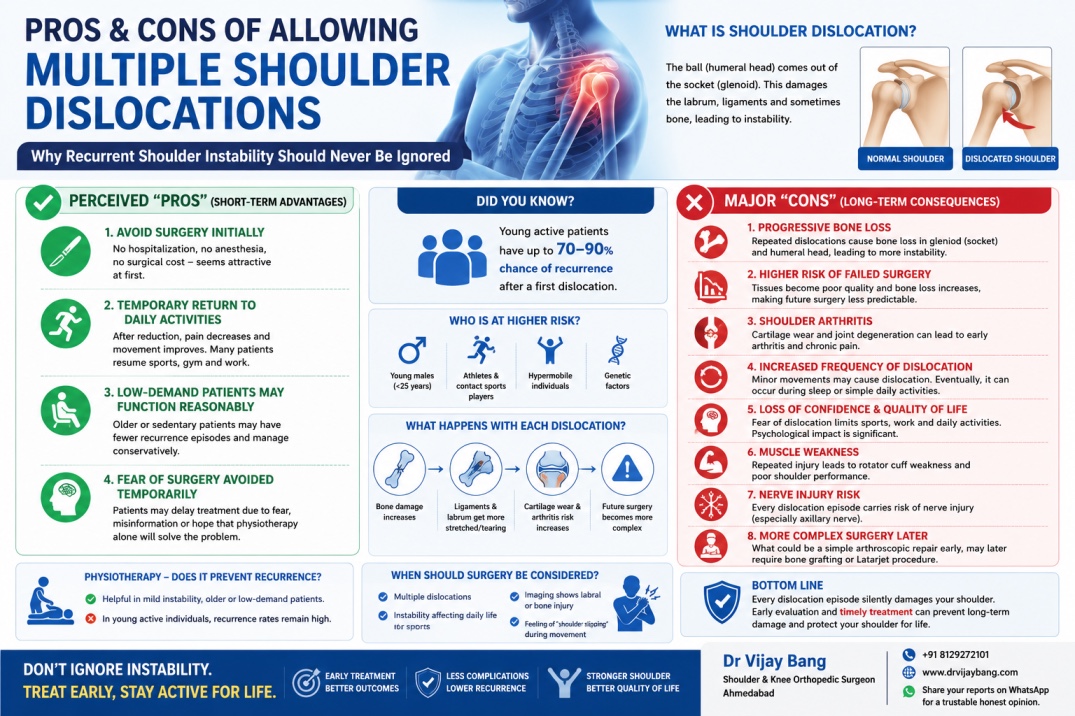
A first-time shoulder dislocation is already a significant injury. However, one of the biggest mistakes patients make is repeatedly “allowing” the shoulder to dislocate again and again without proper treatment.
Many young patients say:
- “It comes out and goes back on its own.”
- “I’ve learned to manage it.”
- “I can still do my activities.”
But recurrent shoulder instability is not a harmless condition.
Over time, every dislocation episode can cause:
- More bone damage
- More cartilage injury
- More ligament stretching
- Higher chance of arthritis
At the same time, some patients temporarily avoid surgery and continue daily life reasonably well—creating the illusion that repeated dislocations are “manageable.”
This article explains the real-world pros and cons of delaying treatment and allowing recurrent shoulder dislocations.
What Happens During a Shoulder Dislocation?
The shoulder is the most mobile joint in the body, making it highly prone to instability.
In a dislocation:
- The humeral head (ball) comes out of the socket
- Ligaments and labrum get damaged
- Sometimes bone injury also occurs
Most recurrent cases involve:
👉 Anterior shoulder dislocation
Why Do Recurrent Dislocations Happen?
After the first dislocation:
- Ligaments become loose
- Labrum may tear
- Shoulder becomes unstable
Young active patients are especially prone to recurrence.
Possible “Pros” of Delaying Surgery or Allowing Recurrent Dislocations
(These are temporary or perceived advantages—not long-term benefits.)
1. Avoiding Surgery Initially
Some patients prefer:
- No hospitalization
- No anesthesia
- No surgical cost
This may seem attractive initially.
2. Temporary Return to Daily Activities
After reduction:
- Pain decreases
- Movement improves
Many patients resume:
- Gym
- Sports
- Work
…until the next dislocation occurs.
3. Some Low-Demand Patients May Function Reasonably
Older or sedentary patients may:
- Experience fewer recurrence episodes
- Manage conservatively
4. Fear of Surgery Is Avoided Temporarily
Many patients postpone treatment because:
- They fear surgery
- They heard negative stories
- They believe physiotherapy alone will solve everything
Major Cons of Allowing Multiple Shoulder Dislocations
This is where the real problem begins.
1. Progressive Bone Loss
Every dislocation can damage:
- Glenoid bone (socket)
- Humeral head
This creates:
👉 Larger defects
👉 More instability
Why is bone loss dangerous?
Because:
- Simple arthroscopic repair may no longer work
- More complex surgery may become necessary
2. Higher Risk of Failed Future Surgery
Early instability surgery usually has:
✔ Better outcomes
✔ Simpler repair
Repeated dislocations:
- Stretch tissues further
- Damage bone
- Increase recurrence risk even after surgery
3. Shoulder Arthritis
Repeated instability causes:
- Cartilage wear
- Joint degeneration
Over years, patients may develop:
👉 Early shoulder arthritis
4. Increased Frequency of Dislocation
Initially:
- Major trauma causes dislocation
Later:
- Minor movement becomes enough
Eventually:
- Shoulder may dislocate during sleep or simple activities
5. Loss of Confidence and Quality of Life
Patients become fearful of:
- Sports
- Gym
- Sudden movements
This psychological instability becomes significant.
6. Muscle Weakness
Repeated injuries reduce:
- Shoulder strength
- Functional performance
7. Nerve Injury Risk
Every dislocation episode risks:
- Axillary nerve injury
- Weakness
- Numbness
8. More Complex Surgery Later
Early surgery may only require:
👉 Arthroscopic Bankart repair
Late neglected instability may require:
- Bone grafting procedures
- Latarjet surgery
- More difficult rehabilitation
Who Is at Highest Risk of Recurrent Dislocation?
- Young males (<25 years)
- Athletes
- Contact sports players
- Hypermobile individuals
Can Physiotherapy Prevent Recurrence?
Sometimes yes—especially in:
- Older patients
- Mild instability
But in young active individuals:
👉 Recurrence rates remain high.
When Should Surgery Be Considered?
Surgery becomes strongly recommended if:
- Multiple dislocations occur
- Instability affects life
- Sports participation is limited
- MRI shows labral or bone injury
Signs You Should Not Ignore
⚠️ Shoulder “slipping” sensation
⚠️ Fear during arm movement
⚠️ Repeated instability episodes
⚠️ Weakness after dislocation
What Is the Best Time for Surgery?
👉 Earlier stabilization usually gives:
- Better outcomes
- Lower recurrence
- Less bone damage
Final Takeaway
The biggest misconception is:
👉 “If the shoulder goes back in place, everything is fine.”
Unfortunately, every repeated dislocation can silently worsen:
- Bone damage
- Cartilage injury
- Long-term shoulder health
While delaying surgery may offer temporary convenience, the long-term consequences can be severe.
✔ Early evaluation
✔ Proper imaging
✔ Timely stabilization
…can protect the shoulder for decades.
Dr Vijay Bang
Shoulder and Knee Orthopedic Surgeon in Ahmedabad
www.drvijaybang.com
Call/whatsapp – +91 8129272101
(share your report on WhatsApp for trustable honest opinion)
Stay Connected with Dr. Vijay Bang for Regular Health Tips:
Instagram: https://www.instagram.com/drvijaybangortho
YouTube: https://www.youtube.com/@drvijaybangortho
Facebook: https://www.facebook.com/drvijaybangortho
Linkedin: https://www.linkedin.com/in/drvijaybangortho/
Keywords
recurrent shoulder dislocation
multiple shoulder dislocations
shoulder instability treatment
shoulder dislocation surgery
Bankart lesion
Latarjet surgery
recurrent shoulder instability complications
best shoulder surgeon Ahmedabad