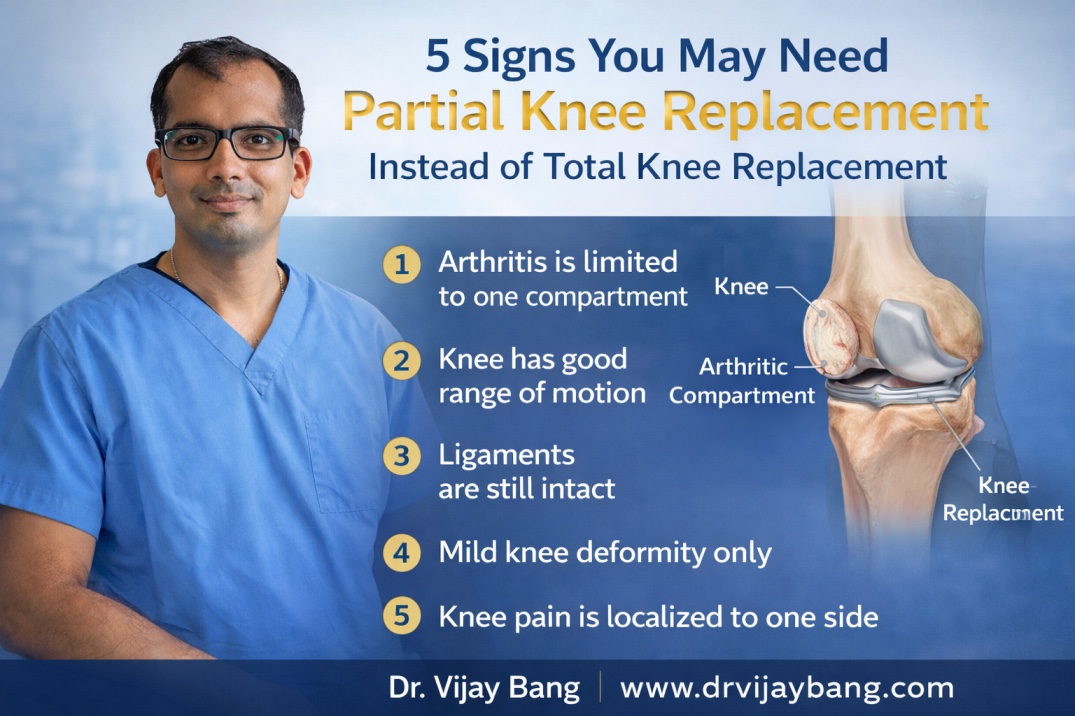
Knee arthritis is one of the most common causes of chronic knee pain, especially among middle-aged and elderly individuals. Many patients who suffer from persistent knee pain eventually hear the term knee replacement surgery. However, one important question often arises:
Do I need a total knee replacement, or can a partial knee replacement be enough?
This is a crucial distinction.
While total knee replacement involves replacing the entire knee joint, partial knee replacement replaces only the damaged portion of the knee. For the right patient, this procedure can offer excellent results with smaller surgery, faster recovery, and more natural knee movement.
Unfortunately, many patients are not aware that they may be candidates for partial knee replacement surgery, and some may unnecessarily undergo total knee replacement.
Understanding the signs that indicate whether a partial knee replacement may be suitable can help patients make more informed decisions about their treatment.
In this article, we will explore five important signs that you may need a partial knee replacement instead of a total knee replacement.
Understanding Partial Knee Replacement
Before discussing the signs, it is helpful to understand what partial knee replacement actually involves.
The knee joint is made up of three compartments:
- Medial compartment (inner side of the knee)
- Lateral compartment (outer side of the knee)
- Patellofemoral compartment (between the kneecap and thigh bone)
In many patients with arthritis, only one compartment of the knee is damaged, while the rest of the joint remains relatively healthy.
In such cases, partial knee replacement replaces only the damaged portion of the joint rather than the entire knee.
This approach preserves:
- Healthy cartilage
- Natural ligaments
- Normal knee mechanics
As a result, patients often experience more natural knee movement and quicker recovery compared with total knee replacement.
Sign 1: Your Knee Arthritis Is Limited to One Part of the Knee
One of the most important factors that determines whether a patient is suitable for partial knee replacement is the location of arthritis.
Many patients with knee pain assume that arthritis affects the entire joint. However, in reality, arthritis often begins in one specific compartment of the knee.
The most commonly affected area is the medial compartment, which is the inner side of the knee.
If imaging studies such as X-rays or MRI scans show that:
- Arthritis is limited to one compartment
- The remaining compartments are healthy
Then partial knee replacement may be an excellent option.
This targeted approach allows surgeons to treat the damaged portion of the knee while preserving the healthy areas.
Patients with isolated compartment arthritis often experience excellent outcomes with partial knee replacement surgery.
Sign 2: Your Knee Still Has Good Range of Motion
Another important indicator that a patient may be suitable for partial knee replacement is good knee movement.
Many patients with advanced arthritis develop:
- Severe stiffness
- Limited knee bending
- Difficulty straightening the knee
These symptoms may indicate widespread joint damage, which often requires total knee replacement.
However, patients who are candidates for partial knee replacement usually retain relatively good knee mobility.
Typical features include:
- Ability to bend the knee beyond 90–100 degrees
- Ability to fully straighten the knee
- Relatively smooth movement of the joint
Preserving good range of motion is important because partial knee replacement works best when the knee’s natural ligaments and movement patterns are still functioning well.
Sign 3: Your Knee Ligaments Are Still Intact
Healthy ligaments play a critical role in determining whether a patient can undergo partial knee replacement.
The knee joint contains several important ligaments that help maintain stability, including:
- Anterior cruciate ligament (ACL)
- Posterior cruciate ligament (PCL)
- Medial collateral ligament
- Lateral collateral ligament
In partial knee replacement, these ligaments are preserved and continue to function normally.
Because the ligaments remain intact, the knee maintains natural movement and stability.
However, if the ACL is severely damaged or absent, a patient may not be an ideal candidate for partial knee replacement.
In contrast, total knee replacement replaces the entire joint structure, making ligament preservation less important.
Therefore, patients with stable knee ligaments are often better candidates for partial knee replacement surgery.
Sign 4: Your Knee Is Stable Without Severe Deformity
Another sign that partial knee replacement may be suitable is minimal knee deformity.
Advanced arthritis can sometimes cause the knee to become significantly misaligned, resulting in:
- Severe bow legs (varus deformity)
- Severe knock knees (valgus deformity)
In these cases, the damage may involve multiple compartments of the knee, making total knee replacement more appropriate.
However, if the deformity is mild to moderate, and arthritis is confined to one compartment, partial knee replacement may still be possible.
Patients with partial knee arthritis often have:
- Mild bowing of the knee
- Localized pain on one side of the joint
- Relatively normal alignment during walking
Correcting the damaged compartment with partial knee replacement can restore alignment while preserving the rest of the knee.
Sign 5: Your Knee Pain Is Localized to One Side
Patients with partial knee arthritis often describe pain that is clearly localized.
Common symptoms include:
- Pain on the inner side of the knee
- Pain while climbing stairs
- Pain during prolonged walking
- Pain that improves with rest
Importantly, the pain is usually not spread throughout the entire knee.
Patients may even point with one finger to the exact location of the pain.
This localized pain pattern often indicates that only one compartment of the knee is affected, making partial knee replacement a potential treatment option.
A detailed clinical examination and imaging studies help confirm the diagnosis.
Advantages of Partial Knee Replacement
When performed in appropriately selected patients, partial knee replacement offers several advantages compared with total knee replacement.
These include:
Smaller Surgery
Partial knee replacement requires smaller incisions and less tissue disruption, which can reduce surgical trauma.
Faster Recovery
Patients often recover more quickly because:
- Less bone is removed
- Ligaments are preserved
- Muscles are less disturbed
Many patients are able to walk on the same day or the next day after surgery.
More Natural Knee Movement
Because the natural ligaments and healthy compartments remain intact, patients often report that the knee feels more natural compared with total knee replacement.
Better Knee Function
Patients may experience:
- Better knee bending
- Improved mobility
- Easier participation in daily activities
Who Is Not a Good Candidate for Partial Knee Replacement?
While partial knee replacement offers many benefits, it is not suitable for every patient.
Patients may require total knee replacement if they have:
- Arthritis affecting multiple compartments
- Severe knee deformity
- Significant ligament damage
- Advanced inflammatory arthritis such as rheumatoid arthritis
In such cases, replacing the entire knee joint provides better long-term results.
A careful evaluation by an orthopaedic surgeon helps determine the most appropriate treatment.
The Importance of Proper Patient Selection
One of the most critical factors in achieving good outcomes with partial knee replacement is proper patient selection.
When performed in the right patient, this procedure can provide:
- Long-lasting pain relief
- Improved mobility
- High patient satisfaction
However, if performed in patients with widespread arthritis, the results may not be as successful.
For this reason, orthopaedic surgeons perform a detailed assessment that includes:
- Clinical examination
- Weight-bearing X-rays
- Sometimes MRI scans
These tests help determine whether partial knee replacement or total knee replacement is the best option.
Recovery After Partial Knee Replacement
Recovery from partial knee replacement surgery is typically faster than recovery after total knee replacement.
Most patients experience:
- Shorter hospital stays
- Faster return to walking
- Quicker rehabilitation
Physiotherapy plays an important role in restoring knee strength and mobility.
Many patients are able to return to their normal daily activities within a few weeks.
However, recovery times can vary depending on:
- Patient age
- Overall health
- Adherence to physiotherapy
Final Thoughts
Knee replacement surgery can dramatically improve the quality of life for patients suffering from severe arthritis. However, not every patient requires a total knee replacement.
For individuals with arthritis affecting only one compartment of the knee, partial knee replacement may offer an effective and less invasive solution.
Understanding the signs that indicate suitability for partial knee replacement can help patients explore all available treatment options.
If you are experiencing persistent knee pain and arthritis symptoms, consulting an experienced orthopaedic specialist can help determine whether partial knee replacement or total knee replacement is the most appropriate treatment for you.
Early evaluation and proper treatment can help restore mobility, reduce pain, and improve overall quality of life.
Dr. Vijay Bang
Orthopaedic Shoulder & Knee Specialist