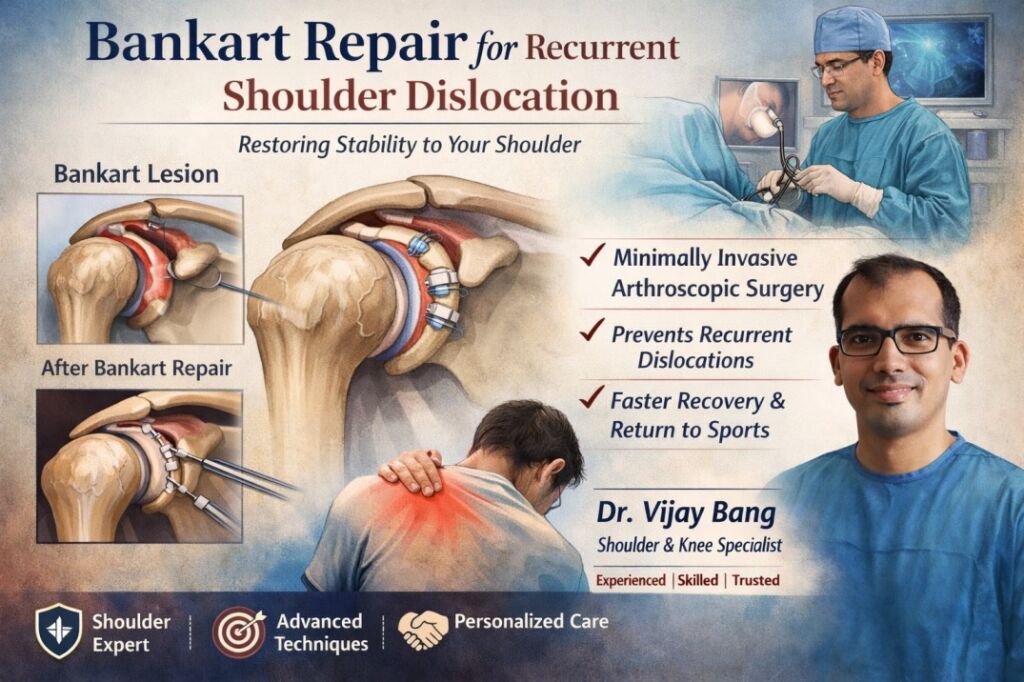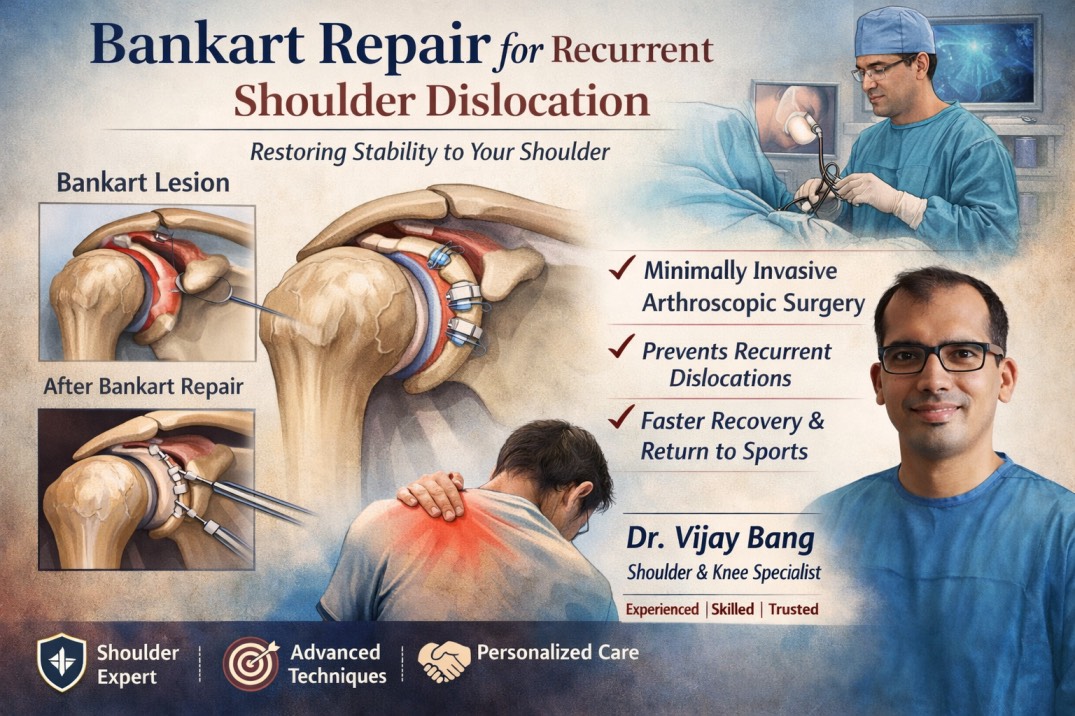
Recurrent Shoulder Dislocation explained by Dr Vijay Bang , among finest Shoulder Surgeon in Ahmedabad.
Dr Vijay Bang
Shoulder Surgeon in Ahmedabad
www.drvijaybang.com
Call/WhatsApp – +91 8129272101
(share your report on WhatsApp for trustable honest opinion)
Stay Connected with Dr. Vijay Bang for Regular Health Tips:
Instagram: https://www.instagram.com/drvijaybangortho
YouTube: https://www.youtube.com/@drvijaybangortho
Facebook: https://www.facebook.com/drvijaybangortho
LinkedIn: https://www.linkedin.com/in/drvijaybangortho/
1. What is a Bankart repair?
Answer:
A Bankart repair is a surgical procedure designed to treat recurrent anterior shoulder dislocation by repairing a Bankart lesion — a tear of the labrum and capsule where the shoulder socket (glenoid) meets the ball (humeral head). This injury weakens the shoulder stabilizers and predisposes the joint to repeated dislocations or subluxations (partial dislocations). In Bankart repair, torn ligamentous tissue is reattached to the front of the glenoid using sutures or anchors, restoring stability.
2. Why do shoulder dislocations keep recurring?
Answer:
After an initial dislocation, the labrum and ligaments often fail to heal fully and leave the shoulder unstable. Each subsequent dislocation worsens damage to bone and soft tissues, creating a vicious cycle that makes further dislocations more likely over time unless treated.
3. What causes a Bankart lesion?
Answer:
A Bankart lesion occurs when the labrum and anterior capsule are torn during shoulder dislocation — usually after a traumatic event like a fall or sports injury. This avulsion removes the “bumper” that keeps the shoulder ball centered on the socket, leading to instability.
4. When is Bankart repair recommended?
Answer:
Bankart repair is commonly recommended when a patient experiences multiple shoulder dislocations or has significant labral damage on imaging (MRI/arthrogram), especially in younger, active individuals who need shoulder stability for daily life or sports performance. It is indicated when non-surgical measures fail to prevent recurrence.
5. How successful is arthroscopic Bankart repair?
Answer:
Arthroscopic Bankart repair — performed through small incisions using a camera — is the most commonly used technique today. Success rates are generally high, with significant improvement in stability and functional outcome scores post-surgery. Modern outcomes show a low recurrence of dislocation when properly indicated and rehabilitated.
6. What is the difference between open and arthroscopic Bankart repair?
Answer:
- Arthroscopic Bankart repair is minimally invasive, uses tiny camera-guided instruments, and typically results in less pain, smaller scars, and faster recovery.
- Open Bankart repair involves a larger incision and direct visualization of structures. Both can be effective, but arthroscopic methods are increasingly preferred.
7. What is remplissage and how does it relate to Bankart repair?
Answer:
Remplissage is an additional procedure sometimes done with Bankart repair when there is a Hill-Sachs lesion — a dent in the humeral head that engages the glenoid and promotes recurrent instability. By filling this defect with soft tissue (capsule/infraspinatus tendon), remplissage reduces the chance of dislocation. Combining Bankart repair with remplissage has shown excellent functional outcomes with minimal loss of motion.
8. How is the procedure performed?
Answer:
- You are placed under anesthesia.
- Arthroscopic portals are made around the shoulder.
- A camera provides video guidance.
- Torn labral tissue is prepared and repaired with suture anchors.
- Optional techniques like remplissage or bone-augmentation (e.g., Latarjet) are considered depending on bone loss.
The anchors secure the labrum back to the glenoid rim, recreating the stabilizing bumper.
9. What is the role of bone loss in Bankart repair decisions?
Answer:
Significant glenoid or humeral bone loss can make standalone Bankart repair less effective. When bone loss exceeds a certain threshold (e.g., >20%), additional procedures like a Latarjet bone block may be recommended for optimal stability.
10. Does Bankart repair guarantee no further dislocations?
Answer:
While Bankart repair greatly reduces the recurrence of dislocations, it does not 100% guarantee prevention. Recurrence rates vary depending on risk factors such as age, bone lesions, ligament laxity, activity level, and biomechanical demands.
11. What happens if dislocation recurs after Bankart repair?
Answer:
Recurrence may occur due to unaddressed bone loss, technical issues, inadequate rehabilitation, or high-risk activity return too early. In such cases, further evaluation may consider revision surgery or alternative procedures like bone augmentation.
12. What are the risk factors for failure after Bankart repair?
Answer:
Risk factors include:
- Younger age (<20 years)
- High activity or contact sports
- Significant Hill-Sachs or glenoid bone lesions
- Shoulder hyperlaxity
- Early return to demanding activities
These increase likelihood of recurrent instability post-repair.
13. How long does recovery take?
Answer:
Recovery after arthroscopic Bankart repair typically includes:
- Sling immobilization for 3–4 weeks
- Progressive physiotherapy up to 3–6 months
- Full return to sports or heavy work often at ~6–9 months
Healing and strengthening are gradual, and patients must closely follow rehab protocols.
14. When can I return to sports or heavy lifting after surgery?
Answer:
Return to high-demand sports or heavy physical labor is usually cleared between 4–9 months, depending on strength, range of motion, and stability regained. Contact or collision sports often require the longest rehabilitation period.
15. Does Bankart repair cause stiffness or loss of motion?
Answer:
Some stiffness or reduced external rotation can occur early post-operatively, which typically improves with guided rehabilitation. Severe or persistent stiffness is uncommon when appropriate physiotherapy is followed.
16. What are the risks and complications?
Answer:
Potential complications include:
- Infection (rare)
- Nerve or vessel injury
- Recurrent instability or dislocation
- Anchor failure or loosening
- Stiffness
Overall complication rates are low with experienced surgeons and adherence to rehab protocols.
17. How much does Bankart repair cost in Ahmedabad?
Answer:
In Ahmedabad, arthroscopic Bankart repair costs can vary based on hospital, implants, surgeon fees, and rehabilitation support, typically ranging between ₹60,000 – ₹2,50,000.
18. What kind of imaging is needed before surgery?
Answer:
- MRI or MR Arthrogram to detect labral tears and associated lesions
- CT scan to assess bone loss
These help plan whether additional procedures are needed.
19. How effective is early Bankart repair after the first dislocation?
Answer:
Some studies suggest that immediate repair after the first dislocation can reduce later recurrence compared to delayed repair — especially in young, athletic populations.
20. Do I need physiotherapy after surgery?
Answer:
Yes — structured rehabilitation is essential for regaining strength, stability, and range of motion, and helps reduce recurrence risk when followed diligently.
21. What makes Dr. Vijay Bang a trusted choice for Bankart repair in Ahmedabad?
Answer:
Choosing the right surgeon is critical for successful outcomes. Here’s why Dr. Vijay Bang is a top choice:
✔ Specialized Shoulder Expertise
Dr. Bang focuses extensively on shoulder conditions and instability surgeries, ensuring deep understanding and precise surgical technique.
✔ High Surgical Standards
He emphasizes patient-specific planning, modern arthroscopic techniques, and use of high-quality suture anchors for optimal stability.
✔ Personalized Care
From diagnosis through rehab, Dr. Bang provides tailored guidance and long-term support — including detailed physiotherapy plans.
✔ Consistent Outcomes
Patients report significant improvement in function and quality of life post-surgery, with careful monitoring to minimize recurrence.
✔ Honesty and Trust
Dr. Bang’s practice emphasizes transparent advice; he reviews imaging personally and discusses all treatment options, including non-surgical alternatives when appropriate.
22. Frequently Asked Patient Questions
Q: Will I have pain after surgery?
A: Some post-operative discomfort is expected but is manageable with medications and subsides as healing progresses.
Q: Can older adults undergo Bankart repair?
A: Yes, older patients can benefit, depending on activity level, tissue quality, and bone condition.
Q: How long do the anchors last?
A: Modern suture anchors are designed for long-term fixation and absorbable or bio-inert materials are commonly used.
Q: What if the repair fails?
A: Revision options include repeat arthroscopic Bankart or bone-augmentation procedures based on cause of failure.
Conclusion
Bankart repair is a well-established and highly effective surgical option for treating recurrent shoulder dislocations when performed with proper indication, meticulous technique, and committed rehabilitation. Outcomes are excellent in most patients, and advancements like arthroscopic repair and remplissage have further improved stability with minimal morbidity.
If you are struggling with recurrent shoulder instability, seeking specialist opinion early — especially from an experienced shoulder surgeon like Dr. Vijay Bang in Ahmedabad — can make a significant difference in long-term shoulder health and performance.
Feel free to contact Dr. Bang with your imaging and reports for a trusted, honest, patient-centric treatment plan.