

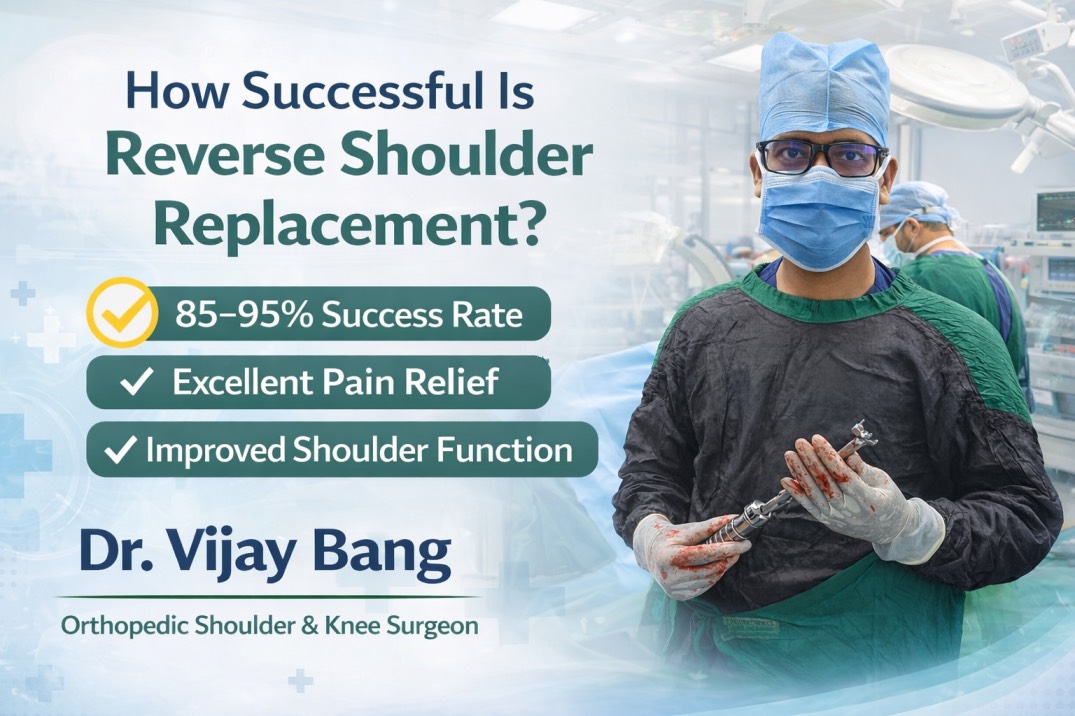
Dr Vijay Bang, among best reverse shoulder replacement surgeon in Ahmedabad explains…
If you have been advised reverse shoulder replacement surgery in Ahmedabad, you are in right place. This article is for you. Here Dr Vijay Bang, explains about success of reverse shoulder replacement surgery in Ahmedabad. Here you go. The overall success rate of reverse shoulder replacement surgery is approximately 85% to 95%.
Success usually means:
- Significant pain relief
- Improved shoulder movement
- Better ability to perform daily activities
- Improved sleep
- Long-lasting implant function
Most patients experience:
- Major reduction in pain within weeks
- Improved arm elevation
- Better strength compared to before surgery
Studies show that more than 9 out of 10 patients are satisfied with the outcome.
What Determines the Success Rate?
Several factors affect the success of reverse shoulder replacement:
1. Correct Patient Selection
The surgery works best for patients with rotator cuff deficiency. If done for the right indication, success is very high.
2. Surgeon Experience
This is a technically demanding procedure. Outcomes are better when performed by an experienced shoulder surgeon.
3. Bone Quality
Strong bone supports implants better, especially in elderly patients.
4. Post-Surgery Rehabilitation
Physiotherapy after surgery plays a major role in final results.
5. Patient Expectations
Realistic expectations improve satisfaction.
Benefits of Reverse Shoulder Replacement Surgery
Patients typically notice:
✔ Dramatic pain relief
✔ Improved ability to lift the arm
✔ Better function in daily activities
✔ Improved sleep quality
✔ Increased independence
Many patients who could not raise their arm before surgery can raise it above shoulder level after recovery.
How Long Does Reverse Shoulder Replacement Last?
Modern implants are designed to last 15 to 20 years or more.
Studies show:
- 90% implants are functioning well at 10 years
- Many last beyond 15 years
Longevity depends on:
- Activity level
- Body weight
- Bone health
- Surgical technique
For elderly patients, implants often last for life.
What Is Recovery Like?
Recovery happens in phases:
First 6 Weeks
- Arm is in a sling
- Gentle exercises start
- Pain gradually decreases
6–12 Weeks
- More active physiotherapy
- Gradual return of motion
- Improved arm lifting
3–6 Months
- Major improvement in function
- Daily activities become easier
6–12 Months
- Final strength and motion improve
Most patients feel significant improvement within 3 months.
Risks and Complications
Like any surgery, reverse shoulder replacement has risks:
- Infection (1–2%)
- Dislocation
- Nerve injury (rare)
- Fracture
- Implant loosening over time
Overall complication rates are low when done by experienced surgeons.
Frequently Asked Questions
1. Is reverse shoulder replacement surgery successful in Ahmedabad?
Yes, reverse shoulder replacement is considered highly successful, especially in patients with rotator cuff damage. Around 85% to 95% of patients report significant pain relief and improved shoulder function. Most patients can lift their arm better than before surgery. Daily activities like eating, grooming, and dressing become much easier. Satisfaction rates are very high when the surgery is done for the right reason.
2. How long does a reverse shoulder replacement last?
Modern reverse shoulder implants typically last 15 to 20 years or even longer. Studies show that most implants are still working well after 10 years. Longevity depends on how active you are and how well the surgery was performed. Elderly patients often never require revision surgery. Proper follow-up and avoiding heavy lifting help the implant last longer.
3. What are the disadvantages of reverse shoulder replacement?
Although the surgery has high success, there are some disadvantages. Shoulder rotation may not become completely normal. Heavy lifting and high-impact sports are not recommended after surgery. There is a small risk of complications like infection or dislocation. In rare cases, revision surgery may be needed. However, for most patients, the benefits far outweigh the risks.
4. Can you live a normal life after reverse shoulder replacement?
Yes, most patients return to a normal and independent life. You can perform daily activities like eating, dressing, combing hair, and light household work. Many patients resume driving after recovery. Light exercises like walking and swimming are usually allowed. However, heavy lifting and contact sports should be avoided.
5. Is reverse shoulder replacement painful?
Pain after surgery is controlled with medications. Most patients say surgical pain is manageable and improves steadily over weeks. Importantly, the severe arthritis pain present before surgery usually disappears. Within a few months, patients feel much better than before surgery. Long-term pain relief is one of the biggest benefits.
6. Who is a good candidate for reverse shoulder replacement?
Patients with massive rotator cuff tears and shoulder arthritis are ideal candidates. Elderly patients with complex fractures also benefit greatly. If previous shoulder surgery has failed, this procedure may help. It is especially helpful when the rotator cuff muscles are not working properly. Your surgeon will evaluate X-rays and MRI before recommending surgery.
7. What is the failure rate of reverse shoulder replacement?
The failure rate is relatively low. About 5% to 10% of patients may experience complications requiring further treatment. Implant loosening or dislocation can happen but is uncommon. Most failures occur in complex cases or due to infection. Overall, long-term success remains very high.
8. How much movement will I regain?
Most patients regain the ability to lift the arm above shoulder level. Forward elevation improves significantly. However, full normal shoulder rotation may not return completely. The goal is pain relief and functional movement, not perfect athletic motion. Patients usually feel a dramatic improvement compared to before surgery.
Is Reverse Shoulder Replacement Worth It?
For patients with severe shoulder pain and poor function due to rotator cuff damage, reverse shoulder replacement is often life-changing.
When pain limits sleep, independence, and daily life, this surgery offers:
- Reliable pain relief
- Functional improvement
- Long-lasting results
Most patients say they wish they had done it earlier.
Final Thoughts
Reverse shoulder replacement surgery has a high success rate of 85–95%. It provides excellent pain relief and functional improvement for the right patients.
If you are suffering from:
- Severe shoulder arthritis
- Rotator cuff tear arthropathy
- Inability to lift your arm
- Failed previous shoulder surgery
This procedure may significantly improve your quality of life.
Always consult an experienced shoulder specialist for proper evaluation.