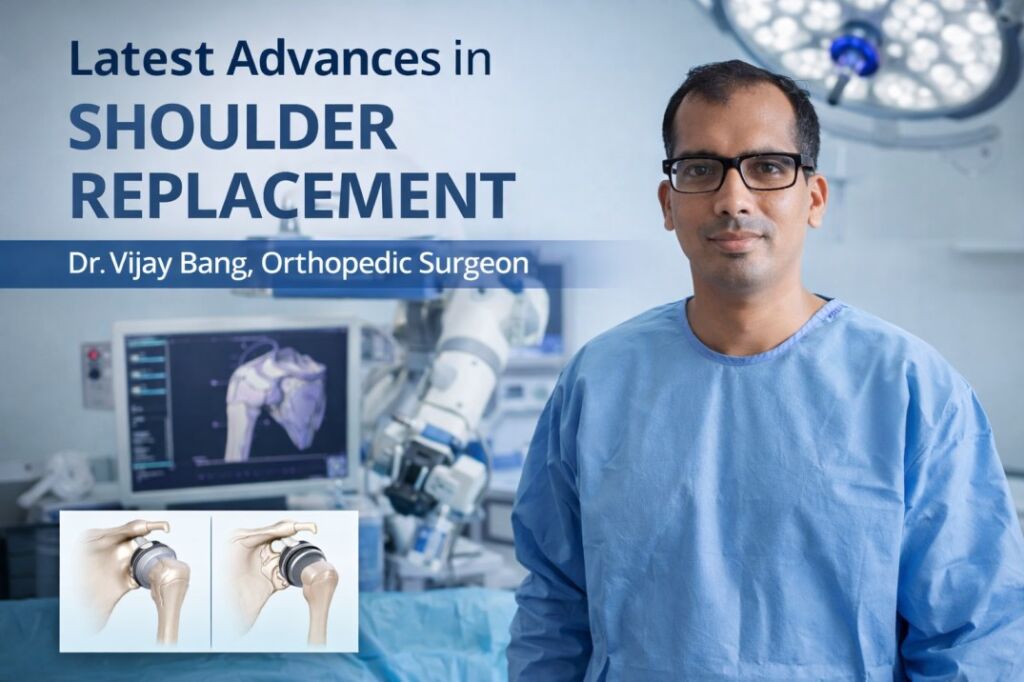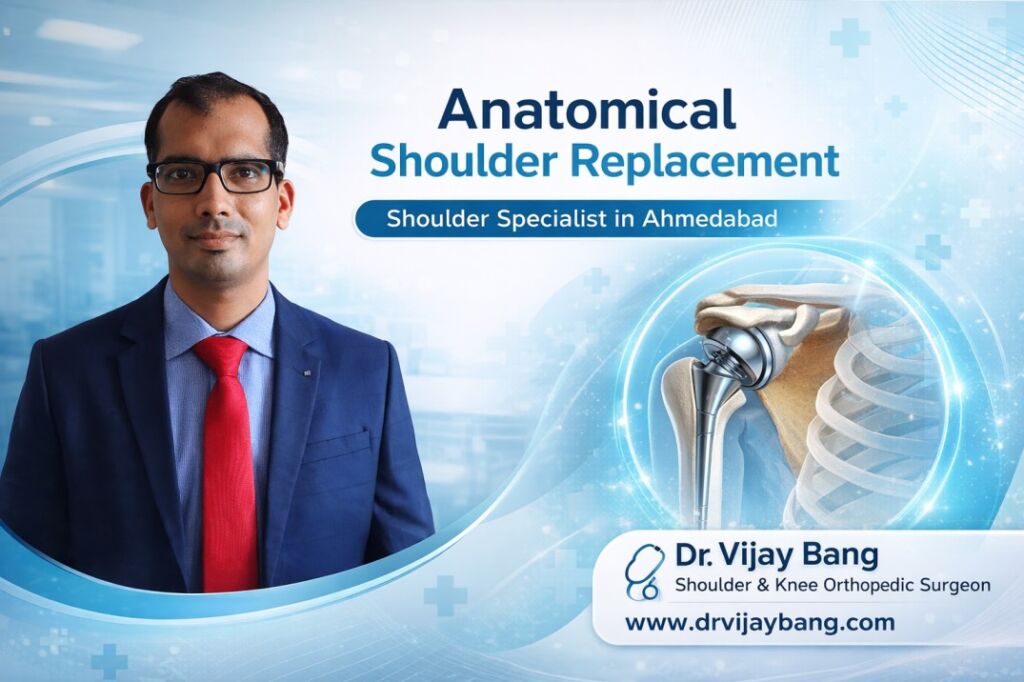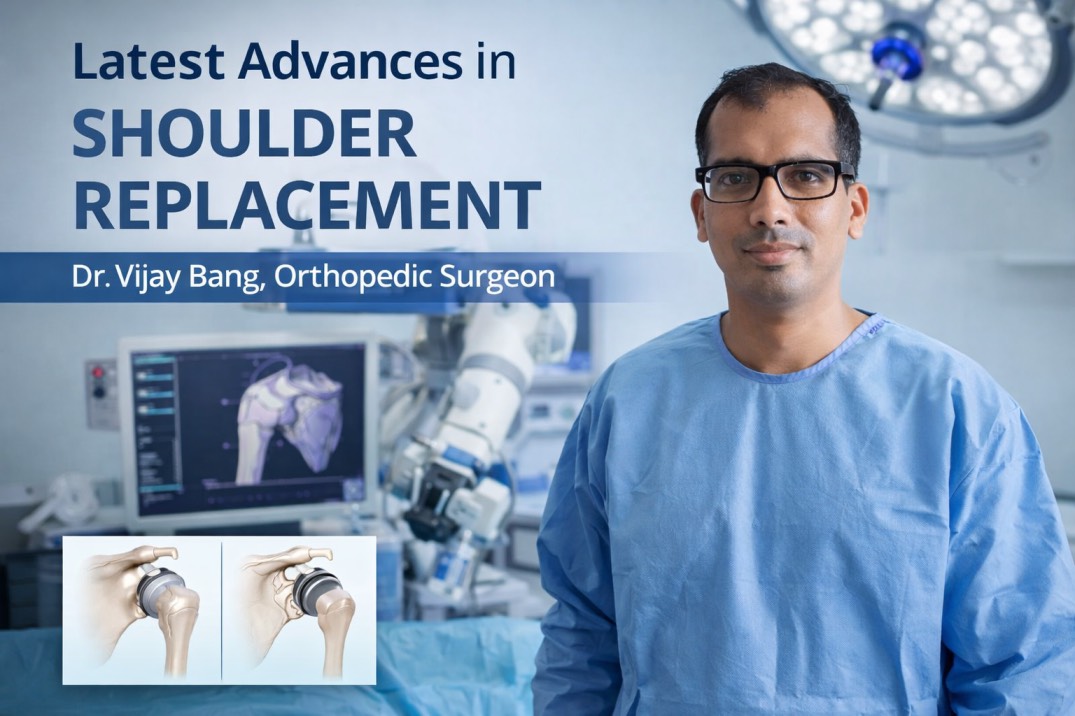
Dr Vijay Bang, Shoulder Specialist in Ahmedabad, gives insights on what are the latest developments in field of shoulder replacement surgery.
Who Is This Article Written For?
This article is written for people who are experiencing chronic shoulder pain, severe shoulder arthritis, or significant loss of shoulder movement and are exploring treatment options. It is especially helpful for:
- Patients suffering from advanced shoulder arthritis
- Individuals with massive rotator cuff tears
- Patients advised to consider shoulder replacement surgery
- People researching the latest treatment options for shoulder joint damage
- Individuals looking for a shoulder specialist in Ahmedabad
- Patients who want to understand how modern technology has improved shoulder replacement outcomes
If shoulder pain is interfering with your daily life—such as lifting your arm, combing your hair, dressing, or sleeping comfortably—modern shoulder replacement surgery may provide significant relief and restore function.
This article explains the latest advances in shoulder replacement surgery, how they benefit patients, and why choosing the right shoulder surgeon is crucial for achieving the best results.
Understanding Shoulder Replacement Surgery
The shoulder joint is a ball-and-socket joint formed by the head of the humerus (upper arm bone) and the glenoid (socket) of the shoulder blade. This joint allows a wide range of motion, making it one of the most mobile joints in the human body.
However, this mobility also makes the shoulder vulnerable to problems such as:
- Severe arthritis
- Rotator cuff tears
- Shoulder fractures
- Joint degeneration
- Recurrent instability
When these conditions cause severe pain and loss of function, shoulder replacement surgery may become the best treatment option.
In shoulder replacement surgery, the damaged parts of the joint are replaced with artificial implants designed to restore smooth movement and reduce pain.
Types of Shoulder Replacement
Modern shoulder surgery includes several types of replacement procedures depending on the patient’s condition.
Anatomical Shoulder Replacement
This procedure replaces the damaged joint while maintaining the natural anatomy of the shoulder. A metal ball replaces the humeral head, and a plastic socket replaces the glenoid.
It is typically used for patients with shoulder arthritis but an intact rotator cuff.
Reverse Shoulder Replacement
Reverse shoulder replacement changes the position of the ball and socket. The ball component is placed on the shoulder blade, while the socket is attached to the humerus.
This design allows the deltoid muscle to compensate for a damaged rotator cuff, making it ideal for patients with massive rotator cuff tears and arthritis.
Partial Shoulder Replacement (Hemiarthroplasty)
In this procedure, only the ball portion of the joint is replaced while the socket remains natural.
It is often used in certain types of fractures or localized joint damage.
Why Shoulder Replacement Has Advanced So Much
Over the last two decades, shoulder replacement surgery has undergone significant technological improvements.
The focus of innovation today includes:
- Better implant design
- Higher surgical precision
- Personalized surgical planning
- Minimally invasive techniques
- Faster patient recovery
These advances allow patients to achieve better pain relief, improved mobility, and longer implant survival.
Latest Advances in Shoulder Replacement Surgery
1. 3D CT-Based Surgical Planning
One of the most important modern developments is 3D surgical planning.
Using CT scans, advanced software creates a detailed three-dimensional model of the patient’s shoulder joint.
This allows surgeons to:
- Study the exact anatomy
- Choose the ideal implant size
- Plan implant positioning
- Anticipate potential challenges before surgery
This technology improves accuracy and reduces complications.
2. Patient-Specific Instrumentation
Another major advancement is the use of customized surgical guides.
Based on 3D imaging, surgeons can create patient-specific instruments that help position implants precisely during surgery.
Benefits include:
- Improved implant alignment
- Reduced surgical errors
- Shorter surgical time
- Better long-term implant stability
3. Stemless Shoulder Replacement Implants
Traditional shoulder replacements required inserting a long metal stem into the arm bone.
New stemless implants are designed to preserve more natural bone.
Advantages include:
- Less bone removal
- Faster recovery
- Easier revision surgery if needed
- Better suitability for younger patients
4. Improved Glenoid Implant Technology
One of the challenges in shoulder replacement has historically been loosening of the glenoid (socket) component.
Modern implants now use advanced fixation techniques and improved materials that significantly reduce this risk.
These new designs improve:
- Implant stability
- Long-term durability
- Overall surgical outcomes
5. Advanced Reverse Shoulder Replacement Designs
Reverse shoulder replacement has revolutionized the treatment of patients with rotator cuff tear arthropathy.
New implant designs now provide:
- Better joint stability
- Reduced dislocation risk
- Improved shoulder movement
- Longer implant lifespan
Many patients who previously had no effective surgical options can now regain significant shoulder function.
6. Tissue-Sparing Surgical Techniques
Modern shoulder replacement surgery increasingly focuses on preserving muscles and soft tissues.
Some newer approaches allow surgeons to perform the procedure while minimizing damage to key muscles such as the subscapularis.
Benefits include:
- Less postoperative pain
- Faster rehabilitation
- Better muscle strength
- Quicker return to daily activities
7. Faster Recovery and Rehabilitation
Advances in surgical techniques and rehabilitation protocols now allow patients to recover faster after shoulder replacement.
Modern recovery strategies focus on:
- Early mobilization
- Better pain control
- Structured physiotherapy
- Gradual strengthening
Many patients today regain good function within a few months after surgery.
Signs You May Need Shoulder Replacement
You may benefit from shoulder replacement surgery if you experience:
- Severe shoulder pain that does not improve with treatment
- Difficulty lifting your arm
- Persistent night pain affecting sleep
- Loss of shoulder movement
- Advanced arthritis seen on imaging
A proper evaluation by a shoulder specialist is essential to determine the most appropriate treatment.
Why Choosing the Right Shoulder Surgeon Is Important
Shoulder replacement surgery requires specialized expertise.
Even with advanced technology, the success of the surgery depends heavily on the surgeon’s experience and precision.
A skilled shoulder surgeon ensures:
- Accurate diagnosis
- Correct procedure selection
- Precise implant positioning
- Proper postoperative rehabilitation
This significantly improves the chances of long-term success.
Why Choose Dr Vijay Bang for Shoulder Replacement?
Dr Vijay Bang is a shoulder and knee orthopedic surgeon in Ahmedabad known for his expertise in treating complex shoulder problems.
Patients consult Dr Vijay Bang for several reasons.
Specialized Shoulder Expertise
Dr Bang focuses extensively on shoulder conditions including:
- Rotator cuff tears
- Shoulder instability
- Shoulder arthritis
- Sports injuries
- Shoulder replacement surgery
Advanced Surgical Techniques
He performs modern procedures including:
- Arthroscopic rotator cuff repair
- Shoulder stabilization surgery
- Anatomical shoulder replacement
- Reverse shoulder replacement
These procedures are designed to restore shoulder movement and reduce pain effectively.
Personalized Patient Care
Every patient receives a thorough evaluation and individualized treatment plan based on their condition, lifestyle, and expectations.
Honest and Ethical Advice
Many patients appreciate Dr Bang’s clear and honest guidance regarding whether surgery is necessary or if non-surgical treatment can be effective.
Focus on Long-Term Outcomes
Dr Bang emphasizes proper rehabilitation, patient education, and long-term joint health to ensure the best possible surgical outcomes.
Frequently Asked Questions About Shoulder Replacement
Is shoulder replacement surgery safe?
Yes. When performed by an experienced shoulder surgeon, shoulder replacement is a safe and effective procedure with high success rates.
How long does shoulder replacement surgery take?
The procedure usually takes 1.5 to 2 hours, depending on the complexity of the case.
How long does recovery take?
Most patients begin gentle movements soon after surgery, with recovery typically taking 3 to 6 months for optimal strength and mobility.
How long do shoulder replacement implants last?
Modern implants typically last 15–20 years or longer, depending on patient activity level and implant design.
Will I regain full shoulder movement after surgery?
Most patients experience significant improvement in pain and mobility, although the exact range of motion depends on the underlying condition and rehabilitation.
Final Thoughts
Shoulder replacement surgery has advanced significantly in recent years thanks to innovations in implant design, imaging technology, surgical planning, and rehabilitation.
These advances allow patients to experience:
- Better pain relief
- Improved shoulder movement
- Faster recovery
- Longer implant lifespan
For individuals suffering from severe shoulder pain or arthritis, modern shoulder replacement surgery can dramatically improve quality of life.
However, the key to successful treatment lies in accurate diagnosis, appropriate surgical planning, and choosing an experienced shoulder surgeon.
About the Author
Dr Vijay Bang
Shoulder and Knee Orthopedic Surgeon in Ahmedabad
www.drvijaybang.com
Call/whatsapp – +91 8129272101
(share your report on WhatsApp for trustable honest opinion)
Stay Connected with Dr. Vijay Bang for Regular Health Tips:
Instagram: https://www.instagram.com/drvijaybangortho
YouTube: https://www.youtube.com/@drvijaybangortho
Facebook: https://www.facebook.com/drvijaybangortho
Linkedin: https://www.linkedin.com/in/drvijaybangortho/