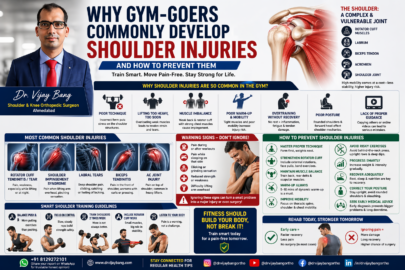
Dr Vijay Bang, among top rated shoulder rotator cuff specialist in Ahmedabad, gives Complete Guide to Quick Recovery, Treatment Options & Long-Term Shoulder Health
A torn rotator cuff is one of the most common causes of shoulder pain, weakness, and difficulty lifting the arm. Whether you are an athlete, working professional, homemaker, or senior citizen, this injury can severely affect daily life.
The first question almost every patient asks is:
“What is the fastest way to heal a torn rotator cuff?”
The honest answer is:
👉 The fastest recovery depends on the type of tear, your age, activity level, and how early proper treatment is started.
In this detailed guide, we will cover everything:
- What is a rotator cuff tear
- Symptoms and causes
- Partial vs full-thickness tear
- Non-surgical vs surgical options
- Fastest recovery strategies
- Post-surgery rehabilitation timeline
- Myths and facts
- Long-term prevention
Who Is This Article For?
This article is for:
- Patients with shoulder pain diagnosed as rotator cuff tear
- Gym goers with lifting injuries
- Athletes with overhead sports injuries
- People above 40 with persistent shoulder weakness
- Individuals searching for:
- “Fastest way to heal rotator cuff tear”
- “Rotator cuff tear treatment”
- “Rotator cuff surgery recovery time”
- “Best rotator cuff specialist”
What Is the Rotator Cuff?
The rotator cuff is a group of four muscles and tendons that stabilize the shoulder joint and allow lifting and rotation.
These muscles include:
- Supraspinatus
- Infraspinatus
- Teres minor
- Subscapularis
They work together to keep the shoulder stable during movement.
When one or more of these tendons tear, pain and weakness develop.
What Causes a Torn Rotator Cuff?
Rotator cuff tears occur due to:
1️⃣ Trauma
- Fall on outstretched hand
- Sudden pulling injury
- Sports accident
2️⃣ Degeneration (Common after 40)
- Age-related wear and tear
- Repeated overhead activity
- Poor blood supply
3️⃣ Overuse
- Gym overtraining
- Cricket bowling
- Swimming
- Painting ceilings
What Are the Symptoms of a Rotator Cuff Tear?
Common symptoms include:
- Shoulder pain while lifting arm
- Pain at night
- Weakness
- Difficulty combing hair
- Trouble reaching behind back
- Clicking or catching sensation
If symptoms persist beyond 2–3 weeks, evaluation is necessary.
What Is the Fastest Way to Heal a Torn Rotator Cuff?
The fastest recovery depends on whether the tear is:
- Partial tear
- Full-thickness tear
- Massive tear
- Acute traumatic tear
- Chronic degenerative tear
Let’s break this down clearly.
Fastest Way to Heal a Partial Rotator Cuff Tear
If the tear is partial (less than 50% thickness):
Step 1: Early Diagnosis
MRI confirms severity.
Step 2: Activity Modification
Avoid overhead lifting.
Step 3: Structured Physiotherapy
Focus on:
- Rotator cuff strengthening
- Scapular stabilization
- Posture correction
Step 4: Anti-inflammatory Measures
- Ice
- Short course medication
- Avoid repeated steroid injections
⏳ Recovery time: 6–12 weeks in many cases.
If pain persists beyond 3 months, surgery may be considered.
Fastest Way to Heal a Full-Thickness Rotator Cuff Tear
A full tear means the tendon is completely detached.
In young and active patients:
👉 Early arthroscopic surgery is often the fastest and most reliable solution.
Why?
Because:
- Tendons retract over time
- Muscle becomes fatty
- Tear becomes irreparable if delayed
⏳ Early surgery within 3–6 months gives best results.
When Is Surgery the Fastest Option?
Surgery is the fastest path to full recovery if:
- Tear is complete
- Patient is young (<60)
- Weakness is significant
- Pain persists despite therapy
- MRI shows tendon retraction
- Injury was traumatic
Delaying surgery can increase healing time and reduce success rate.
What Happens During Rotator Cuff Surgery?
Modern treatment is usually arthroscopic (keyhole surgery).
Procedure includes:
- Cleaning damaged tissue
- Reattaching tendon using anchors
- Smoothing bone spurs
Advantages:
- Small incisions
- Less pain
- Faster recovery
- High success rate
How Long Does Rotator Cuff Surgery Recovery Take?
Phase 1 (0–4 Weeks)
- Sling protection
- Passive movements only
Phase 2 (4–8 Weeks)
- Gradual active motion
Phase 3 (8–16 Weeks)
- Strengthening
Phase 4 (4–6 Months)
- Return to full activity
Athletes may take 6–8 months.
Can a Rotator Cuff Tear Heal Naturally?
Small partial tears may heal symptomatically with therapy.
But:
- Full tears do not reattach naturally
- Large tears worsen with time
- Chronic tears develop muscle degeneration
Natural healing depends on tear size and patient age.
What Is the Role of PRP in Fast Healing?
PRP (Platelet Rich Plasma):
- May reduce inflammation
- May help partial tears
But:
- Does not repair complete tears
- Evidence is still evolving
PRP is not a substitute for surgery in large tears.
What Slows Down Rotator Cuff Healing?
- Smoking
- Diabetes
- Poor physiotherapy compliance
- Repeated steroid injections
- Heavy lifting too early
- Delayed surgery in full tears
Healing requires patience and structured rehabilitation.
Can I Continue Gym With a Rotator Cuff Tear?
Not recommended.
Avoid:
- Overhead presses
- Bench press heavy
- Pull-ups
- Deadlifts with poor form
Improper exercise worsens tear.
What Is the Success Rate of Rotator Cuff Surgery?
Success rate ranges between:
- 85–95% in small to medium tears
- 70–85% in large tears
- Lower in massive chronic tears
Early treatment improves outcomes significantly.
What Happens If a Rotator Cuff Tear Is Ignored?
Ignoring it may lead to:
- Chronic pain
- Progressive tear enlargement
- Muscle atrophy
- Irreparable tear
- Shoulder arthritis
- Reverse shoulder replacement in future
Early intervention prevents complications.
Fastest Recovery Tips After Rotator Cuff Surgery
1️⃣ Follow sling protocol strictly
2️⃣ Do physiotherapy regularly
3️⃣ Maintain protein-rich diet
4️⃣ Control blood sugar
5️⃣ Avoid smoking
6️⃣ Sleep properly
7️⃣ Avoid sudden movements
8️⃣ Attend follow-up visits
Recovery speed depends heavily on compliance.
Myths About Rotator Cuff Tears
Myth: All tears need surgery
Fact: Partial tears often respond to therapy.
Myth: Surgery means permanent weakness
Fact: Most patients regain full strength.
Myth: Pain equals tear severity
Fact: Some large tears have mild pain.
Myth: Steroid injection cures tear
Fact: It reduces pain temporarily.
When Should You See a Shoulder Specialist?
- Pain persists beyond 2–3 weeks
- Weakness present
- Night pain severe
- Arm cannot be lifted
- Sudden injury followed by weakness
Early evaluation = faster recovery.
Final Answer: What Is the Fastest Way to Heal a Torn Rotator Cuff?
It depends:
- Small partial tear → Structured physiotherapy
- Acute full tear in young patient → Early arthroscopic repair
- Chronic large tear → Early surgical consultation
- Massive tear → Advanced reconstructive procedure
The fastest path is not always the easiest one.
It is the one chosen correctly at the right time.
Early diagnosis + correct treatment plan = fastest safe recovery.
Why Select Dr Vijay Bang for Rotator Cuff Treatment in Ahmedabad
- Exclusive focus on shoulder surgery
- Expertise in arthroscopic rotator cuff repair
- Evidence-based treatment decisions
- Advanced minimally invasive techniques
- Honest opinion — surgery only when required
- Structured rehabilitation guidance
- High success rate in shoulder procedures
If you are searching for:
- Rotator cuff specialist in Ahmedabad
- Rotator cuff surgeon in Ahmedabad
- Shoulder pain treatment
- Arthroscopic shoulder surgery
Early expert consultation can save your shoulder.
Dr Vijay Bang
Shoulder and Knee Orthopedic Surgeon in Ahmedabad
🌐 www.drvijaybang.com
📞 Call/WhatsApp: +91 8129272101
(Share your report on WhatsApp for trustworthy honest opinion)
Stay Connected for Regular Health Tips
Instagram: https://www.instagram.com/drvijaybangortho
YouTube: https://www.youtube.com/@drvijaybangortho
Facebook: https://www.facebook.com/drvijaybangortho
LinkedIn: https://www.linkedin.com/in/drvijaybangortho/