Rotator Cuff – The Most Mobile Joint in the Human Body
The shoulder joint is a remarkable structure.
It allows you to:
- Lift your arm overhead
- Rotate in multiple directions
- Perform complex movements like throwing, lifting, and reaching
But this extreme mobility comes at a cost:
The shoulder is the most unstable joint in the human body.
Understanding its anatomy is essential not only for medical professionals but also for patients suffering from shoulder pain, stiffness, or injury.
This guide will give you a deep, structured, and clinically relevant understanding of the shoulder joint anatomy, simplified for clarity but detailed enough for real insight.
Who Is This Article Meant For?
This article is ideal for:
- Patients with shoulder pain wanting to understand their condition
- Medical students and physiotherapists
- Athletes and fitness enthusiasts
- Individuals recovering from shoulder injuries
Overview of the Shoulder Joint
The shoulder is not just one joint—it is a complex of multiple joints working together.
The Shoulder Complex Includes:
- Glenohumeral joint (main joint)
- Acromioclavicular joint
- Sternoclavicular joint
- Scapulothoracic articulation
Together, they allow maximum mobility with coordinated stability.
1. Glenohumeral Joint (Main Shoulder Joint)
This is the primary joint people refer to as the “shoulder.”
Structure
- Ball: Head of the humerus (upper arm bone)
- Socket: Glenoid cavity of the scapula (shoulder blade)
Key Feature
The socket is very shallow → allows wide movement but reduces stability.
Type of Joint
- Ball-and-socket joint
- Synovial joint
Movements Allowed
- Flexion (forward movement)
- Extension (backward movement)
- Abduction (lifting sideways)
- Adduction (bringing arm down)
- Internal rotation
- External rotation
- Circumduction (circular motion)
2. Bones of the Shoulder Joint
A. Humerus (Upper Arm Bone)
- Forms the “ball” of the joint
- Smooth articular surface
- Covered with cartilage
B. Scapula (Shoulder Blade)
A flat triangular bone with important landmarks:
Key Parts
- Glenoid cavity (socket)
- Acromion (roof of shoulder)
- Coracoid process
C. Clavicle (Collar Bone)
- Connects arm to the body
- Acts as a strut to maintain shoulder position
3. The Glenoid Labrum
What Is It?
A ring of fibrocartilage around the glenoid.
Function
- Deepens the socket
- Increases stability
- Acts as attachment for ligaments
Clinical Relevance
Damage to this structure is called:
- Labral Tear
4. Capsule of the Shoulder Joint
What Is It?
A fibrous envelope surrounding the joint.
Function
- Holds joint structures together
- Allows movement while maintaining stability
Clinical Importance
Tightening of capsule leads to:
- Frozen Shoulder
5. Ligaments of the Shoulder
Ligaments provide passive stability.
Major Ligaments
1. Glenohumeral Ligaments
- Superior
- Middle
- Inferior
👉 Prevent excessive movement
2. Coracohumeral Ligament
- Supports upper part of joint
3. Coracoacromial Ligament
- Forms arch over shoulder
Clinical Relevance
This arch can cause:
- Shoulder Impingement Syndrome
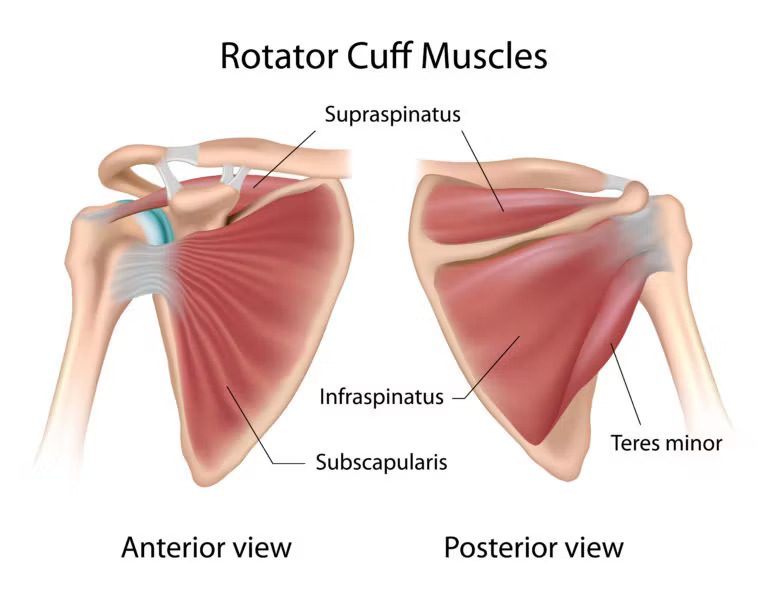
6. Rotator Cuff Muscles
These are the most important functional stabilizers.
Muscles
- Supraspinatus
- Infraspinatus
- Teres Minor
- Subscapularis
Function
- Stabilize humeral head
- Assist in movement
Clinical Importance
Injury leads to:
- Rotator Cuff Tear
7. Bursa Around the Shoulder
What Is Bursa?
Fluid-filled sacs that reduce friction.
Important Bursa
- Subacromial bursa
Function
- Allows smooth movement between structures
Clinical Condition
Inflammation causes:
- Bursitis
- Impingement pain
8. Muscles Around the Shoulder (Beyond Rotator Cuff)
Major Muscles
Deltoid
- Main muscle for lifting arm
Pectoralis Major
- Helps in pushing movements
Latissimus Dorsi
- Helps in pulling movements
Trapezius
- Controls scapular movement
Importance
These muscles work together to:
- Maintain posture
- Coordinate movement
- Prevent injury
9. Scapulothoracic Rhythm
What Is It?
Coordinated movement between:
- Scapula
- Humerus
Ratio
For every:
- 2° of humeral movement
- 1° of scapular movement
Why It Matters
Disruption leads to:
- Shoulder dysfunction
- Pain
- Reduced mobility
10. Blood Supply of the Shoulder
Major Arteries
- Axillary artery
- Circumflex humeral arteries
Importance
- Supplies muscles and tendons
- Poor blood supply → delayed healing
11. Nerve Supply of the Shoulder
Major Nerves
- Axillary nerve
- Suprascapular nerve
- Musculocutaneous nerve
Function
- Control muscle movement
- Provide sensation
Clinical Relevance
Nerve injury can cause:
- Weakness
- Numbness
- Loss of function
12. Why the Shoulder Is Prone to Injury
Key Reasons
1. High Mobility
More movement → less stability
2. Shallow Socket
Less bony support
3. Dependence on Soft Tissues
Muscles and ligaments do most of the work
Result
Higher risk of:
- Dislocations
- Tendon injuries
- Chronic pain
13. Common Shoulder Problems Explained Through Anatomy
1. Rotator Cuff Tear
Damage to stabilizing tendons
2. Frozen Shoulder
Capsule becomes tight and inflamed
3. Shoulder Impingement Syndrome
Structures get compressed under acromion
4. Labral Tear
Damage to stabilizing cartilage
14. Functional Anatomy: How Everything Works Together
The shoulder is not just structures—it’s coordination.
Movement Example: Lifting Your Arm
- Rotator cuff stabilizes
- Deltoid lifts arm
- Scapula rotates
- Ligaments control excess motion
If Any Component Fails
👉 Pain
👉 Weakness
👉 Restricted movement
15. Key Takeaways for Patients
What You Should Remember
- Shoulder is highly mobile but unstable
- Stability depends on muscles, not bones
- Small injuries can lead to major dysfunction
- Early understanding prevents long-term damage
Conclusion
Understanding the anatomy of your shoulder joint is the first step toward:
- Accurate diagnosis
- Effective treatment
- Faster recovery
When you understand your shoulder, you make better decisions about your health.
About the Author
Dr Vijay Bang
Shoulder and Knee Orthopedic Surgeon in Ahmedabad
www.drvijaybang.com
Call/whatsapp – +91 8129272101
(share your report on WhatsApp for trustable honest opinion)
Stay Connected with Dr. Vijay Bang for Regular Health Tips:
Instagram: https://www.instagram.com/drvijaybangortho
YouTube: https://www.youtube.com/@drvijaybangortho
Facebook: https://www.facebook.com/drvijaybangortho
Linkedin: https://www.linkedin.com/in/drvijaybangortho/