Shoulder Surgeon in Ahmedabad explains…
Who Is This Article For?
This article is carefully written for:
- Patients experiencing persistent shoulder pain or stiffness
- Individuals who feel weakness while lifting the arm
- People confused after searching online about their symptoms
- Diabetic patients or those above 40 years with gradual restriction in movement
- Gym-goers or working professionals with sudden shoulder injury
- Anyone trying to decide whether they need an MRI or specialist consultation
If you are unsure what exactly is causing your shoulder pain, this guide will help you understand it clearly and scientifically.
The Most Common Misdiagnosis I See in My Practice
In my daily orthopedic practice, one statement I hear very frequently is:
👉 “Doctor, I think I have frozen shoulder.”
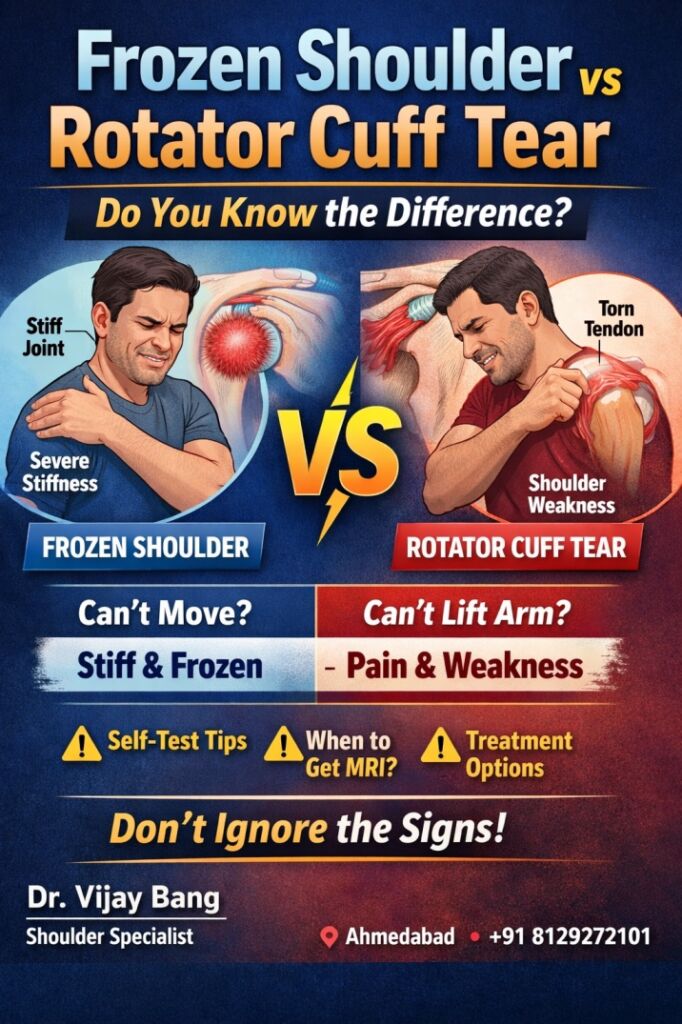
However, after proper clinical examination, many of these patients are actually diagnosed with a rotator cuff tear, not frozen shoulder.
This confusion happens because both conditions:
- Cause pain
- Limit movement
- Affect daily life activities
But here is the most important point:
👉 Their treatment is completely different.
If misdiagnosed:
- A rotator cuff tear can worsen and become irreparable
- Frozen shoulder can become severely stiff and prolonged
🦴 Understanding Frozen Shoulder (Adhesive Capsulitis)
Frozen shoulder is a condition where the capsule of the shoulder joint becomes inflamed, thickened, and tight. This leads to a progressive loss of movement.
📊 Stages of Frozen Shoulder
- Freezing Stage (Painful Stage)
- Gradual onset of pain
- Pain worsens at night
- Movement starts becoming limited
- Frozen Stage (Stiffness Stage)
- Pain may reduce slightly
- Severe stiffness develops
- Daily activities become difficult
- Thawing Stage (Recovery Stage)
- Gradual improvement in motion
- Can take months to years
🔍 Key Clinical Features
- Slow onset over weeks to months
- Severe stiffness in all directions
- Both active and passive movements restricted
- Common in diabetics and thyroid patients
- Often no history of major injury
💪 Understanding Rotator Cuff Tear
The rotator cuff is a group of muscles and tendons that stabilize the shoulder joint and allow smooth movement.
A tear can occur due to:
- Sudden injury (fall, lifting weight)
- Degeneration with age
- Repetitive overhead activity
🔍 Key Clinical Features
- Sudden or gradual onset pain
- Weakness in lifting arm
- Difficulty with overhead activities
- Pain while sleeping on affected side
- Passive movement is relatively preserved
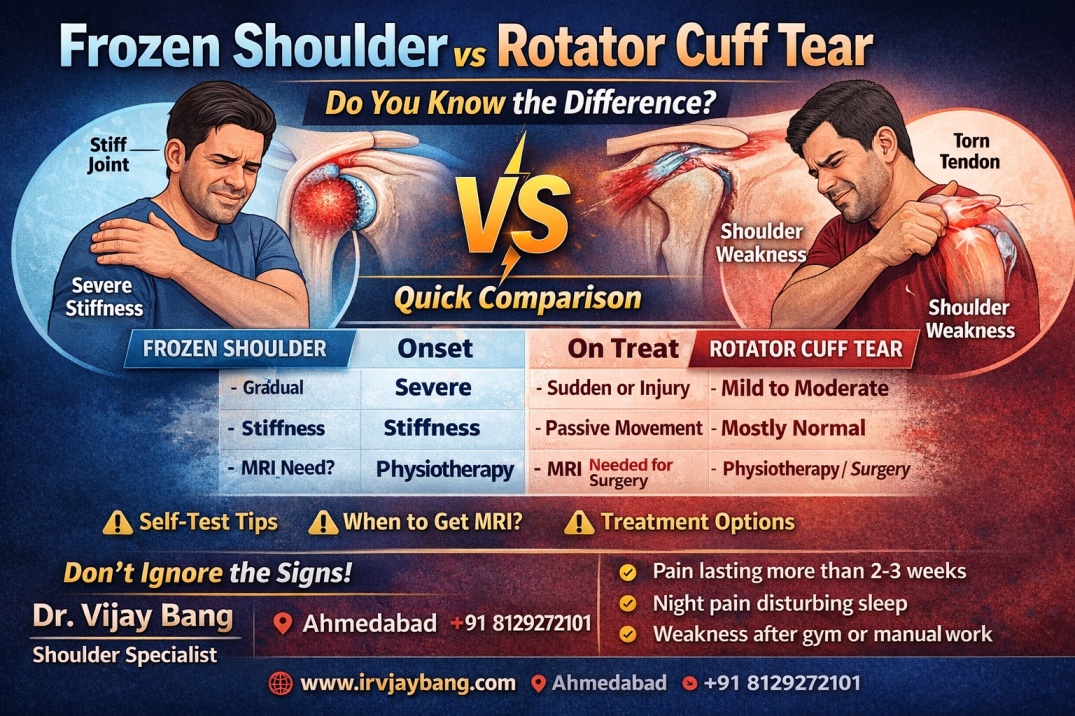
⚡ Detailed Comparison: Frozen Shoulder vs Rotator Cuff Tear
| Feature | Frozen Shoulder | Rotator Cuff Tear |
|---|---|---|
| Onset | Gradual | Sudden/degenerative |
| Pain Pattern | Diffuse, dull | Sharp, activity-related |
| Stiffness | Severe | Mild to moderate |
| Weakness | Minimal | Significant |
| Passive Movement | Restricted | Mostly preserved |
| Night Pain | Present | Often severe |
| Age Group | 40+ (esp diabetics) | 35+ or injury cases |
🧪 Advanced Self-Assessment at Home
These simple tests can give you a rough idea, but they are not a substitute for clinical examination.
1. Assisted Lift Test
Try lifting your affected arm using your opposite hand.
- If you cannot lift at all → Suggests Frozen Shoulder
- If you can lift but it hurts → Suggests Rotator Cuff Tear
2. External Rotation Test
Keep your elbow at your side and rotate your arm outward.
- Severe restriction → Frozen Shoulder
- Pain with weakness → Rotator Cuff Tear
3. Drop Arm Test
Lift your arm fully and slowly bring it down.
- Sudden drop → Rotator Cuff Tear
🚨 Red Flag Signs You Should NOT Ignore
- Shoulder pain lasting more than 2–3 weeks
- Difficulty lifting arm above shoulder level
- Sudden weakness after minor trauma
- Severe night pain affecting sleep
- Progressive stiffness (especially in diabetics)
Ignoring these symptoms can delay recovery and worsen the condition.
🧠 Do You Really Need an MRI?
This is one of the most common concerns among patients.
👉 The answer is: Not always.
- Frozen shoulder is primarily a clinical diagnosis
- Rotator cuff tear may require MRI only if surgery is being considered
❗ Common Mistake:
Patients directly get MRI without consultation, leading to:
- Unnecessary expense
- Confusing reports
- Delayed treatment
👉 A skilled shoulder specialist can diagnose correctly in most cases without MRI initially.
💊 Treatment: Why Correct Diagnosis Matters
🔹 Frozen Shoulder Treatment
- Physiotherapy is the backbone
- Pain management with medications
- Intra-articular injections (if required)
- Gradual recovery over months
- Surgery is rarely needed
🔹 Rotator Cuff Tear Treatment
- Small tears → Physiotherapy + strengthening
- Moderate tears → Injection + rehab
- Large tears → Arthroscopic surgery
👉 Delay in treating rotator cuff tear can make it irreparable, requiring more complex surgery.
❌ Common Mistakes Patients Make
- Self-diagnosing through internet searches
- Ignoring symptoms for months
- Taking repeated painkillers
- Avoiding movement completely
- Consulting non-specialists initially
- Delaying surgery when actually required
⏳ Why Early Diagnosis Is Critical
Early diagnosis helps:
- Prevent worsening of stiffness
- Avoid chronic tendon damage
- Reduce treatment duration
- Improve functional outcomes
👉 In shoulder conditions, time is tissue.
🏥 Why Choose Dr Vijay Bang for Shoulder Pain in Ahmedabad?
- Exclusive focus on shoulder disorders
- Expertise in arthroscopy and minimally invasive surgery
- Accurate diagnosis based on clinical evaluation
- Avoidance of unnecessary tests and treatments
- Transparent and ethical patient care
❓ Frequently Asked Questions
1. How can I be sure whether I have frozen shoulder or rotator cuff tear?
It is often difficult for patients to differentiate between the two conditions because both present with pain and limited movement. However, the key difference lies in stiffness versus weakness. Frozen shoulder causes global restriction of movement, even when someone else tries to move your arm. In contrast, rotator cuff tear mainly causes weakness, and passive movement is usually preserved. A proper clinical examination by a shoulder specialist is the most reliable way to differentiate between them. Sometimes imaging like MRI may be required, but not always.
2. Can frozen shoulder and rotator cuff tear occur together?
Yes, both conditions can coexist in some patients, especially in older individuals. A rotator cuff tear can sometimes lead to secondary stiffness, mimicking frozen shoulder. Similarly, prolonged frozen shoulder may weaken surrounding muscles, making diagnosis complex. In such cases, clinical expertise becomes very important to identify the dominant pathology. Treatment strategy may need to address both stiffness and tendon injury simultaneously. Ignoring one condition can delay overall recovery.
3. Which condition is more painful and serious?
Both conditions can cause significant discomfort, but rotator cuff tears are often associated with more severe night pain and functional weakness. Frozen shoulder causes more stiffness, which can be extremely frustrating in daily activities. In terms of seriousness, a rotator cuff tear can become irreversible if not treated early. Frozen shoulder, although painful, usually improves over time with proper management. Therefore, early diagnosis is crucial in both conditions to avoid complications.
4. Do all rotator cuff tears require surgery?
No, not all rotator cuff tears need surgery. Small or partial tears can often be managed successfully with physiotherapy and strengthening exercises. Pain relief measures and injections may also help in selected cases. However, large or complete tears, especially in active individuals, may require surgical repair. Delaying surgery in such cases can lead to tendon retraction and muscle wasting. The decision should always be individualized based on patient age, activity level, and severity of tear.
5. How long does frozen shoulder take to recover completely?
Frozen shoulder typically goes through three stages and can take anywhere from 6 months to 18 months for full recovery. The duration varies depending on early diagnosis and adherence to physiotherapy. Some patients recover faster with timely intervention, including injections. Delayed treatment can prolong stiffness and discomfort. Regular guided exercises play a crucial role in recovery. Patience and consistency are key for successful treatment.
6. Is physiotherapy enough for both conditions?
Physiotherapy is the main treatment for frozen shoulder and plays a very important role in rotator cuff tears as well. In frozen shoulder, it helps in improving joint mobility and reducing stiffness. In rotator cuff tears, physiotherapy focuses on strengthening surrounding muscles and improving function. However, physiotherapy alone may not be sufficient in large tears requiring surgical repair. It is important to follow a structured rehabilitation plan under expert guidance. Incorrect exercises can sometimes worsen the condition.
7. Can I continue gym or exercise with shoulder pain?
Continuing gym activities without proper diagnosis can worsen the condition significantly. In rotator cuff tear, heavy lifting can increase the size of the tear. In frozen shoulder, improper exercises can increase pain and inflammation. It is advisable to modify activities based on the diagnosis. Guided physiotherapy is much safer than self-directed workouts. Always consult a specialist before resuming exercise.
8. What happens if I ignore shoulder pain for months?
Ignoring shoulder pain can lead to worsening of the underlying condition. Frozen shoulder may progress to severe stiffness, making recovery longer and more difficult. Rotator cuff tears can enlarge and become irreparable over time. Chronic pain can also affect sleep and overall quality of life. Early treatment is always simpler, less expensive, and more effective. Delayed intervention often leads to more complex management.
📢 Final Takeaway
If you are experiencing shoulder pain and difficulty lifting your arm:
👉 Do not assume it is just frozen shoulder.
👉 Do not delay proper diagnosis.
Early identification of the problem can:
- Save time
- Reduce pain
- Prevent surgery in many cases
📍 Consultation & Contact
Dr Vijay Bang
Shoulder and Knee Orthopedic Surgeon in Ahmedabad
www.drvijaybang.com
Call/whatsapp – +91 8129272101
(share your report on WhatsApp for trustable honest opinion)
🔗 Stay Connected with Dr. Vijay Bang for Regular Health Tips:
Instagram: https://www.instagram.com/drvijaybangortho
YouTube: https://www.youtube.com/@drvijaybangortho
Facebook: https://www.facebook.com/drvijaybangortho
Linkedin: https://www.linkedin.com/in/drvijaybangortho/
Shoulder Specialist in Ahmedabad
frozen shoulder vs rotator cuff tear, shoulder pain can’t lift arm, rotator cuff tear symptoms India, frozen shoulder treatment Ahmedabad, adhesive capsulitis vs rotator cuff tear, shoulder stiffness causes, when to do MRI shoulder, best shoulder specialist Ahmedabad