Complete Patient Guide with Prevention, Diagnosis & Treatment
Introduction
Rotator cuff injuries are among the most common causes of shoulder pain seen in orthopedic practice. One of the most frequently asked—and often misunderstood—questions by patients is:
“Doctor, my MRI shows a partial tear. Will it become a full tear?”
The short answer is:
👉 Yes, a partial rotator cuff tear can progress into a full-thickness tear if not managed properly.
But the real answer is far more complex and depends on multiple factors such as age, activity level, tendon quality, biomechanics, and treatment approach.
Understanding Rotator Cuff Tears
What is the rotator cuff?
The rotator cuff is a group of four muscles and tendons that stabilize the shoulder joint and allow movement:
- Supraspinatus
- Infraspinatus
- Teres minor
- Subscapularis
These tendons help you:
- Lift your arm
- Rotate your shoulder
- Perform overhead activities
What is a partial rotator cuff tear?
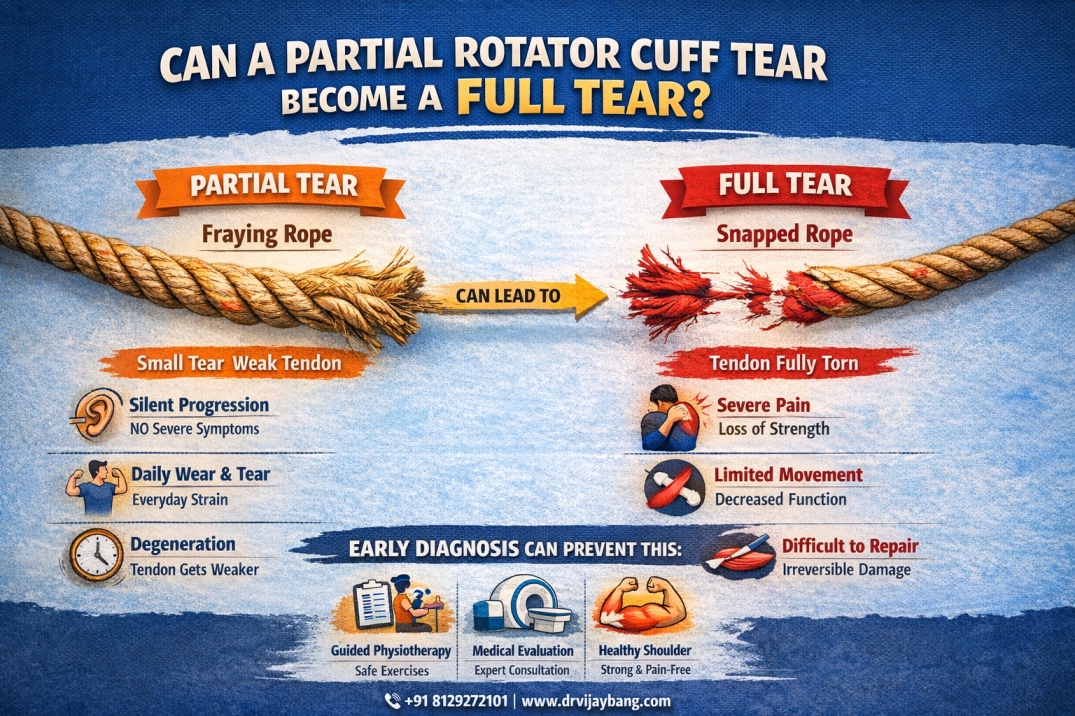
A partial rotator cuff tear means the tendon is damaged but not completely torn.
Types include:
- Articular-sided tear (inner side)
- Bursal-sided tear (outer side)
- Interstitial tear (within tendon)
👉 Think of it like a rope that is fraying but not snapped.
What is a full-thickness rotator cuff tear?
A full tear means:
- Tendon is completely detached
- There is a gap in the tendon
- Muscle loses its normal function
👉 Like a rope completely broken into two parts.
Can a Partial Tear Become a Full Tear?
Is progression from partial to full tear possible?
Yes. This is clinically proven and commonly seen.
Studies show:
- 30% to 50% of partial tears progress over time
- Risk increases with age and activity
Why does a partial tear worsen over time?
There are multiple reasons:
1. Poor blood supply
Rotator cuff tendons have limited healing capacity
2. Continuous stress
Daily activities:
- Lifting
- Reaching
- Sleeping on shoulder
…keep irritating the tear
3. Degeneration
With age:
- Tendon becomes weaker
- Micro-tears accumulate
4. Biomechanical imbalance
Weak muscles → more strain on injured tendon
How fast can a partial tear become full?
There is no fixed timeline:
- Some tears stay stable for years
- Others worsen within months
Factors affecting speed:
- Age > 40 years
- Diabetes
- Smoking
- Heavy physical activity
- Poor physiotherapy
Symptoms of Tear Progression
How do I know my partial tear is getting worse?
Watch for these warning signs:
Increasing pain
- Especially at night
- Pain disturbing sleep
Loss of strength
- Difficulty lifting arm
- Trouble holding objects
Reduced range of motion
- Cannot raise arm fully
Sudden worsening
- After minor injury
Is pain always present in tear progression?
No.
👉 Some patients have silent progression
- Tear increases without symptoms
- Later presents as severe dysfunction
Risk Factors for Progression
Who is at highest risk of developing a full tear?
Age-related risk
- 40 years: moderate risk
- 60 years: high risk
Does lifestyle affect tear progression?
Yes.
High-risk activities:
- Gym (incorrect technique)
- Heavy lifting
- Overhead sports (tennis, cricket, badminton)
Medical conditions that worsen tears
- Diabetes
- Thyroid disorders
- Obesity
Does smoking affect rotator cuff healing?
Yes.
Smoking:
- Reduces blood supply
- Delays healing
- Increases tear progression risk
Diagnosis of Partial vs Full Tear
Which test is best for diagnosis?
MRI (Gold standard)
- Shows size and type of tear
- Detects progression
Can X-ray detect rotator cuff tear?
No.
X-ray only shows:
- Bone changes
- Arthritis
Do all partial tears need MRI follow-up?
Not always.
But repeat MRI is recommended if:
- Symptoms worsen
- No improvement with treatment
Natural History (What Happens if Untreated?)
What happens if a partial tear is ignored?
Possible outcomes:
- Tear enlargement
- Full-thickness tear
- Muscle atrophy
- Fatty degeneration
- Irreversible damage
What is fatty degeneration?
When tendon is torn long-term:
- Muscle converts into fat
- Repair success decreases
👉 This is why early diagnosis matters
Treatment Options
Can partial rotator cuff tear heal on its own?
Rarely.
But symptoms can improve with:
- Physiotherapy
- Lifestyle modification
Non-surgical treatment options
1. Physiotherapy
- Strengthening exercises
- Scapular stabilization
2. Medications
- Painkillers
- Anti-inflammatory drugs
3. Activity modification
- Avoid overhead stress
4. Injections
- Steroid injections (temporary relief)
Does physiotherapy prevent progression?
Yes—if done correctly.
But:
👉 Wrong or aggressive exercise can worsen tear
When is surgery required?
Indications:
- Persistent pain > 3 months
- Loss of function
- Tear progression
- Young active patients
Surgical Treatment
What surgery is done for rotator cuff tear?
Arthroscopic rotator cuff repair
- Minimally invasive
- Tendon is stitched back
Is surgery successful?
Success rate:
- 85–95% in early cases
What happens if surgery is delayed?
Delayed surgery may lead to:
- Irreparable tear
- Poor outcomes
- Chronic pain
Prevention of Tear Progression
How can I prevent my partial tear from becoming full?
Key strategies:
1. Early diagnosis
Don’t ignore shoulder pain
2. Proper physiotherapy
Guided exercises only
3. Avoid high-risk activities
- Heavy lifting
- Overhead strain
4. Maintain shoulder strength
Balanced muscle strengthening
5. Control medical conditions
- Diabetes
- Weight
Frequently Asked Questions
Can a small rotator cuff tear become large?
Yes. Small tears often enlarge over time if untreated.
Can exercise worsen a rotator cuff tear?
Yes, especially:
- Incorrect exercises
- Heavy resistance training
Is surgery necessary for partial tears?
Not always. Depends on:
- Symptoms
- Activity level
- Tear progression
Can I live with a rotator cuff tear?
Yes, but:
- Quality of life may reduce
- Risk of worsening remains
What is the best sleeping position?
- Sleep on opposite side
- Use pillow support
Can physiotherapy cure rotator cuff tear?
It cannot repair tendon, but:
- Improves function
- Reduces pain
Is PRP effective?
Results are mixed:
- May help early cases
- Not a replacement for surgery
Why Shoulder Specialist Matters
Why are rotator cuff tears often mismanaged?
Because:
- General treatment is applied
- Shoulder biomechanics ignored
Why consult a shoulder specialist?
Because:
- Accurate diagnosis
- Tailored treatment
- Better surgical outcomes
Why Choose Dr. Vijay Bang
- Specialized in shoulder and knee surgery
- Extensive experience in rotator cuff repair
- Evidence-based treatment approach
- Focus on patient education and transparency
Conclusion
👉 Yes, a partial rotator cuff tear can become a full tear.
But the key message is:
✔ Early diagnosis
✔ Correct treatment
✔ Timely intervention
…can prevent progression and avoid surgery in many cases.
Ignoring symptoms or improper treatment can lead to:
- Irreversible damage
- Complex surgery
- Poor outcomes
Dr Vijay Bang
Shoulder and Knee Orthopedic Surgeon in Ahmedabad
www.drvijaybang.com
Call/whatsapp – +91 8129272101
(share your report on WhatsApp for trustable honest opinion)
Stay Connected with Dr. Vijay Bang for Regular Health Tips:
Instagram: https://www.instagram.com/drvijaybangortho
YouTube: https://www.youtube.com/@drvijaybangortho
Facebook: https://www.facebook.com/drvijaybangortho
Linkedin: https://www.linkedin.com/in/drvijaybangortho/
Keywords
partial rotator cuff tear progression
can partial rotator cuff tear become full
rotator cuff tear treatment
shoulder pain causes
rotator cuff surgery India
arthroscopic shoulder surgery
rotator cuff tear symptoms worsening
best doctor for rotator cuff tear Ahmedabad
non surgical treatment rotator cuff
when to operate rotator cuff tear