Introduction
Shoulder pain is often ignored until it starts affecting daily life. One of the most important—but frequently underdiagnosed—causes of chronic shoulder pain is Shoulder Osteoarthritis.
Patients commonly present with complaints like:
- “My shoulder is stiff and painful.”
- “I hear grinding sounds while moving my arm.”
- “Pain is worse at night and affecting sleep.”
Many initially try:
- Physiotherapy
- Painkillers
- Home remedies
…but when relief is temporary or incomplete, the real cause often turns out to be degenerative joint disease.
👉 The key question is:
Is shoulder osteoarthritis reversible? And when does it require surgery?
This comprehensive guide answers every important question in detail.
Section 1: What is Shoulder Osteoarthritis?
What is osteoarthritis of the shoulder joint?
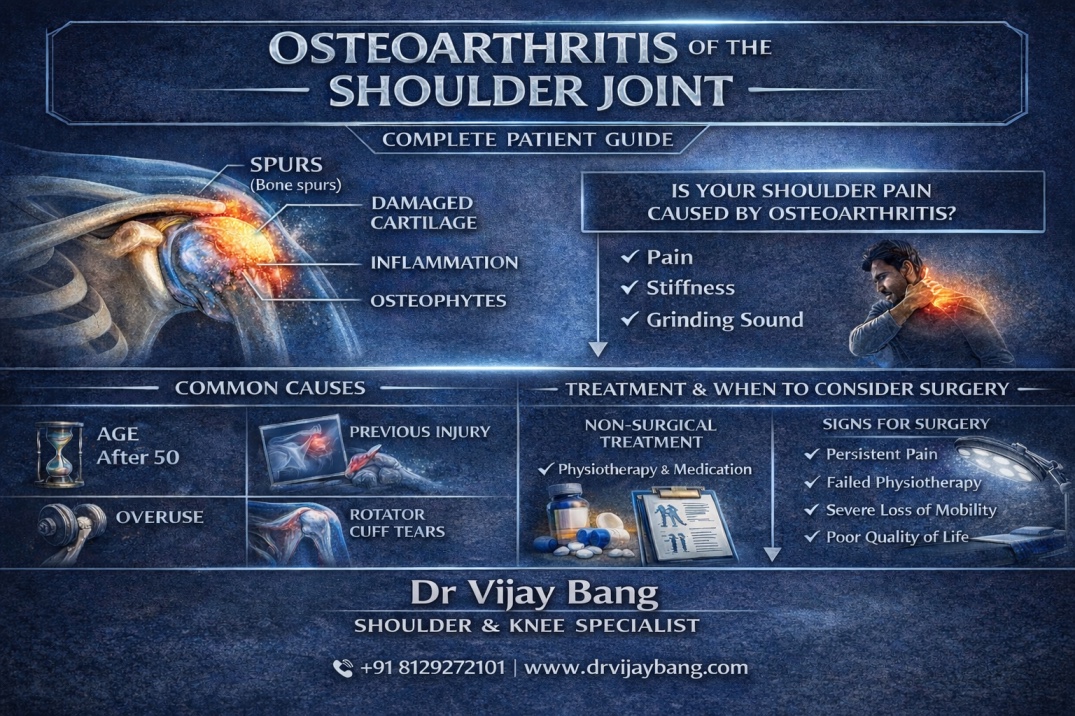
Osteoarthritis is a condition where:
- The protective cartilage in a joint wears down over time
- Bones begin to rub against each other
- This leads to pain, stiffness, and reduced movement
When it affects the shoulder joint (glenohumeral joint), it is called shoulder osteoarthritis.
Which joint is involved in shoulder osteoarthritis?
The main joint affected is the:
- Glenohumeral joint (ball-and-socket joint)
It involves:
- Humeral head (ball)
- Glenoid (socket)
What happens inside the joint?
Over time:
- Cartilage becomes thin
- Joint space reduces
- Bone spurs (osteophytes) form
- Inflammation increases
👉 Result:
- Pain
- Stiffness
- Loss of smooth movement
Section 2: Causes of Shoulder Osteoarthritis
What causes shoulder osteoarthritis?
1. Age-related wear and tear
- Most common cause
- Seen after 50 years
2. Previous injury
- Shoulder fractures
- Dislocations
- Rotator cuff tears
3. Rotator cuff arthropathy
Long-standing rotator cuff tear leads to:
- Joint instability
- Abnormal movement
- Arthritis
4. Overuse
- Repetitive overhead activities
- Heavy lifting
5. Genetic predisposition
Some individuals are more prone due to:
- Family history
- Joint structure
6. Inflammatory conditions
- Rheumatoid arthritis
- Autoimmune diseases

Section 3: Symptoms of Shoulder Osteoarthritis
What are the early symptoms?
- Mild pain with activity
- Occasional stiffness
- Slight reduction in movement
What are the advanced symptoms?
- Severe pain even at rest
- Night pain
- Grinding or clicking sound
- Significant stiffness
- Weakness
Why does shoulder arthritis pain increase at night?
- Reduced distractions
- Joint inflammation
- Pressure while lying
Is stiffness more important than pain?
Yes.
👉 In shoulder arthritis:
- Stiffness is a key feature
- Movement gradually becomes restricted
Section 4: Diagnosis
How is shoulder osteoarthritis diagnosed?
1. Clinical examination
- Range of motion
- Pain pattern
2. X-ray
Shows:
- Joint space narrowing
- Bone spurs
3. MRI
Used if:
- Soft tissue involvement suspected
- Rotator cuff evaluation needed
Can it be confused with frozen shoulder?
Yes.
👉 Both have:
- Pain
- Stiffness
But:
- Frozen shoulder is reversible
- Osteoarthritis is degenerative
Section 5: Stages of Shoulder Osteoarthritis
What are the stages?
Stage 1 (Mild)
- Minimal cartilage loss
- Mild symptoms
Stage 2 (Moderate)
- Reduced joint space
- Increasing pain
Stage 3 (Severe)
- Significant cartilage loss
- Bone-on-bone contact
Stage 4 (End-stage)
- Complete joint destruction
- Severe disability
Section 6: Natural Course (What Happens If Untreated?)
Does shoulder osteoarthritis worsen over time?
Yes.
👉 It is a progressive disease.
What happens if untreated?
- Increasing pain
- Severe stiffness
- Functional disability
- Poor quality of life
Section 7: Non-Surgical Treatment
Can shoulder osteoarthritis be cured without surgery?
No.
👉 It can be managed, not reversed.
What are the non-surgical options?
1. Physiotherapy
- Improves mobility
- Strengthens muscles
2. Medications
- Painkillers
- Anti-inflammatory drugs
3. Activity modification
- Avoid overhead strain
- Reduce heavy lifting
4. Injections
- Steroid injections
- Temporary relief
Does physiotherapy help in arthritis?
Yes, but:
- Limited benefit in advanced stages
Section 8: When Non-Surgical Treatment Fails
How do you know conservative treatment is failing?
- Persistent pain
- Poor sleep
- Reduced function
When should you consider surgery?
- Severe symptoms
- Failed conservative treatment
- Poor quality of life
Section 9: Surgical Treatment Options
What surgery is done for shoulder arthritis?
1. Shoulder Replacement Surgery
Types:
Total Shoulder Replacement
- Replaces both ball and socket
Reverse Shoulder Replacement
- Used when rotator cuff is damaged
What is reverse shoulder replacement?
A specialized procedure where:
- Anatomy is reversed
- Deltoid muscle compensates for rotator cuff
Who needs reverse shoulder replacement?
- Rotator cuff tear + arthritis
- Elderly patients
What are the benefits of surgery?
- Pain relief
- Improved movement
- Better quality of life
Section 10: Recovery After Surgery
How long does recovery take?
- Initial recovery: 6 weeks
- Full recovery: 3–6 months
Is physiotherapy needed after surgery?
Yes.
👉 Essential for:
- Movement
- Strength
Section 11: Prevention
Can shoulder osteoarthritis be prevented?
Not completely, but progression can be slowed.
Prevention strategies
- Maintain shoulder strength
- Avoid overuse
- Treat injuries early
- Control diabetes
Section 12: Frequently Asked Questions
What is the best treatment for shoulder osteoarthritis?
Depends on stage:
- Early: physiotherapy + medication
- Advanced: surgery
Is shoulder arthritis serious?
Yes, if untreated:
- Can lead to severe disability
Can exercise cure shoulder arthritis?
No, but:
- Helps manage symptoms
Is shoulder replacement safe?
Yes, with high success rates
What happens if I delay surgery?
- Joint damage worsens
- Surgery becomes more complex
Section 13: Why Shoulder Specialist Matters
Why is shoulder arthritis often mismanaged?
Because:
- Symptoms overlap with other conditions
- General treatment is applied
Why consult a shoulder specialist?
- Accurate diagnosis
- Right timing of surgery
- Better outcomes
Section 14: Why Choose Dr. Vijay Bang
- Specialized in shoulder surgery
- Expertise in joint replacement
- Evidence-based approach
- Focus on patient education
Conclusion
👉 Shoulder osteoarthritis is a progressive condition.
While early stages can be managed conservatively,
advanced stages often require surgical intervention.
The key is:
✔ Early diagnosis
✔ Proper treatment
✔ Timely decision-making
Signature Block
Dr Vijay Bang
Shoulder and Knee Orthopedic Surgeon in Ahmedabad
www.drvijaybang.com
Call/whatsapp – +91 8129272101
(share your report on WhatsApp for trustable honest opinion)
Stay Connected with Dr. Vijay Bang for Regular Health Tips:
Instagram: https://www.instagram.com/drvijaybangortho
YouTube: https://www.youtube.com/@drvijaybangortho
Facebook: https://www.facebook.com/drvijaybangortho
Linkedin: https://www.linkedin.com/in/drvijaybangortho/
Keywords
shoulder osteoarthritis treatment
glenohumeral arthritis
shoulder replacement surgery India
reverse shoulder replacement
shoulder pain causes
arthritis shoulder symptoms
best shoulder surgeon Ahmedabad
non surgical shoulder arthritis treatment
when to do shoulder replacement