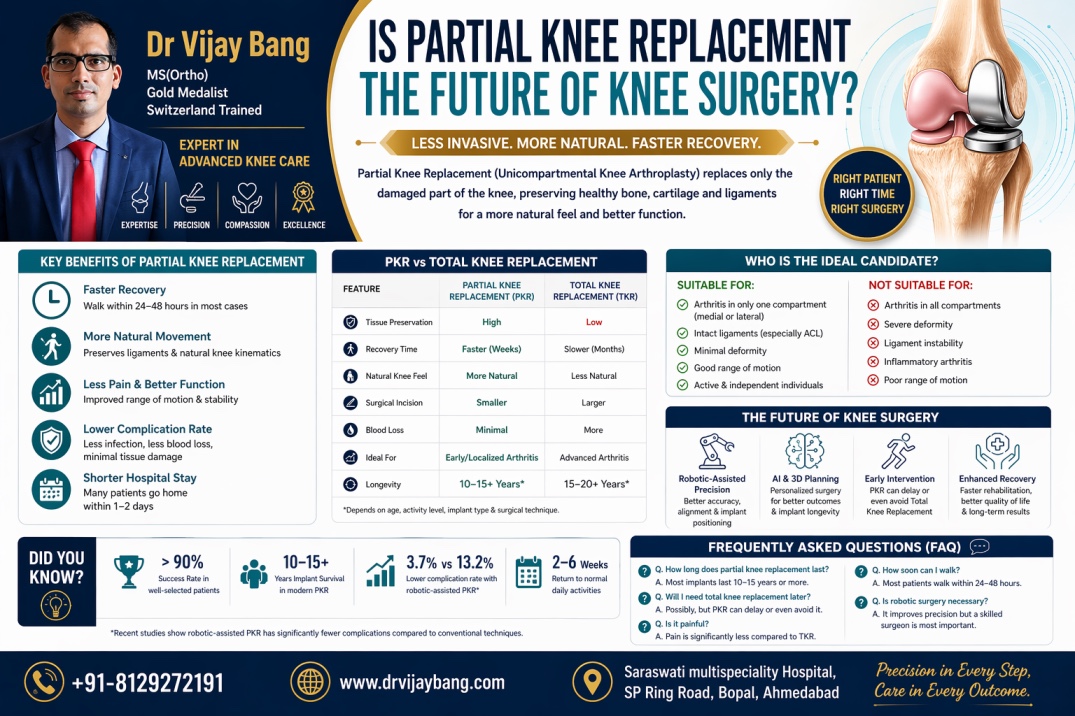
Knee replacement surgery has evolved dramatically over the last two decades. From conventional total knee replacement (TKR) to minimally invasive techniques and now robotic-assisted procedures, orthopedics is witnessing a paradigm shift. Among these innovations, partial knee replacement (PKR)—also known as unicompartmental knee arthroplasty (UKA)—is gaining significant attention.
But the big question remains:
👉 Is partial knee replacement truly the future of knee surgery—or just a niche solution for selected patients?
What is Partial Knee Replacement?
Partial knee replacement is a surgical procedure where only the damaged compartment of the knee joint is replaced, instead of replacing the entire knee as in total knee replacement.
🦵 The Knee Has 3 Compartments:
- Medial (inner)
- Lateral (outer)
- Patellofemoral (front)
👉 In PKR, only one compartment is replaced, preserving:
- Healthy cartilage
- Ligaments (including ACL in many cases)
- Natural knee biomechanics
Why Partial Knee Replacement is Gaining Popularity
1. Preservation of Natural Knee Anatomy
Unlike total knee replacement, PKR:
- Preserves ligaments
- Maintains natural kinematics
- Feels more like a “normal knee”
2. Minimally Invasive Surgery
- Smaller incision
- Less muscle damage
- Less blood loss
3. Faster Recovery
Patients often:
- Walk within 24 hours
- Resume daily activities in weeks
4. Better Functional Outcomes
Patients report:
- More natural movement
- Better range of motion
5. Lower Complication Rates (in selected patients)
Modern studies show:
- Reduced surgical trauma
- Lower infection risk
Latest Advances in Partial Knee Replacement
🔬 1. Robotic-Assisted Surgery
Robotic technology is revolutionizing PKR.
- Improves implant positioning
- Reduces human error
- Enhances precision
Additionally, robotic systems allow:
- Personalized planning
- Real-time adjustments
- Better alignment
👉 This directly translates to longer implant life and better patient satisfaction.
🔬 2. Improved Implant Design
Modern implants:
- Last longer
- Mimic natural joint motion
- Reduce wear
🔬 3. Better Patient Selection Criteria
Earlier, poor outcomes were due to:
- Wrong patient selection
Now:
- Imaging (MRI, CT)
- AI-based planning
- Better clinical protocols
→ have improved success rates significantly.
🔬 4. Long-Term Outcome Evidence
Recent studies show:
- High implant survivorship even after 10 years
- Low progression of arthritis in other compartments
🔬 5. Rise of Personalized Surgery
Future trends include:
- AI-assisted planning
- 3D modeling
- Customized implants
Partial vs Total Knee Replacement: The Core Debate
| Feature | Partial Knee Replacement | Total Knee Replacement |
|---|---|---|
| Tissue preservation | High | Low |
| Recovery | Faster | Slower |
| Natural feel | Better | Artificial |
| Surgical trauma | Minimal | More |
| Indication | Early/limited arthritis | Advanced arthritis |
| Revision risk | Slightly higher | Lower |
👉 Conclusion:
- PKR is not a replacement for TKR
- It is a superior option in the right patient
Who is the Ideal Candidate for Partial Knee Replacement?
✅ Best Candidates:
- Arthritis in only one compartment
- Intact ligaments (especially ACL)
- Minimal deformity
- Good range of motion
- Active lifestyle
❌ Not Suitable For:
- Advanced arthritis in all compartments
- Severe deformity
- Ligament instability
- Inflammatory arthritis (e.g., rheumatoid)
Is Partial Knee Replacement Overused or Underused?
Interestingly, evidence suggests:
👉 PKR is underused globally
Reasons:
- Surgeon preference
- Technical difficulty
- Lack of training
But with robotics and better awareness:
- Adoption is increasing rapidly
Clinical Outcomes: What Does Science Say?
📊 Short-Term Outcomes
- Faster recovery
- Less pain
- Shorter hospital stay
📊 Medium-Term Outcomes
- High patient satisfaction
- Better mobility
📊 Long-Term Outcomes
- High survivorship rates (>90% in selected cases)
📊 Robotic Advantage
- Lower complication rates
- Better implant positioning
Limitations of Partial Knee Replacement
Let’s be practical—PKR is not perfect.
⚠️ 1. Strict Patient Selection
Only ~20–30% of patients qualify
⚠️ 2. Risk of Disease Progression
Other compartments may develop arthritis later
⚠️ 3. Revision Surgery
May require conversion to TKR in future
⚠️ 4. Surgeon Dependency
Results highly depend on:
- Experience
- Precision
Is Robotic Partial Knee Replacement the Game-Changer?
Robotics is pushing PKR toward the future.
Advantages:
- Sub-millimeter precision
- Personalized alignment
- Reduced implant errors
Studies show:
- Lower complications
- Better accuracy in bone cuts
👉 However:
- Not mandatory
- Skilled surgeon still most important
Future of Knee Surgery: Where is it Heading?
🔮 1. Personalized Orthopedics
- Patient-specific implants
- AI-based planning
🔮 2. Robotic + AI Integration
Emerging research is working on:
- Autonomous robotic assistance
- Real-time decision-making
🔮 3. Shift Toward Early Intervention
- More PKR in younger patients
- Delay or avoid total knee replacement
🔮 4. Day-Care Knee Replacement
- Same-day discharge
- Rapid recovery protocols
So… Is Partial Knee Replacement the Future?
✔ YES — In Selected Patients
- Early arthritis
- Active individuals
- Single compartment disease
❌ NO — As a Universal Solution
- Not suitable for all patients
- Total knee replacement still gold standard for advanced arthritis
👉 Final Truth:
The future is not PKR vs TKR…
The future is “Right Surgery for the Right Patient.”
Frequently Asked Questions
❓ 1. How long does partial knee replacement last?
Most modern implants last 10–15 years or more, depending on patient activity and surgical precision.
❓ 2. Is partial knee replacement better than total knee replacement?
Not always. It is better only in selected patients with limited arthritis.
❓ 3. Can partial knee replacement fail?
Yes, due to:
- Disease progression
- Implant wear
- Incorrect patient selection
❓ 4. Is robotic knee replacement worth it?
It improves precision and may reduce complications, but:
👉 Surgeon experience matters more than technology
❓ 5. How long is recovery?
- Walking: 1–2 days
- Normal activity: 3–6 weeks
- Full recovery: ~3 months
❓ 6. Can young patients undergo partial knee replacement?
Yes, especially:
- Active individuals
- Early arthritis cases
❓ 7. Will I need total knee replacement later?
Possibly. PKR can:
- Delay TKR
- Sometimes avoid it
❓ 8. Is surgery painful?
Pain is significantly less compared to total knee replacement due to:
- Minimal tissue damage
❓ 9. What is the success rate?
In ideal patients:
👉 Success rates exceed 90%
❓ 10. How do I know if I need partial or total knee replacement?
This requires:
- Clinical evaluation
- X-rays / MRI
- Expert orthopedic opinion
Conclusion
Partial knee replacement is one of the most exciting advancements in modern orthopedics. With the integration of robotics, better implants, and improved patient selection, it is rapidly becoming a preferred option for early knee arthritis.
However, it is not a one-size-fits-all solution.
👉 The future of knee surgery lies in:
- Precision
- Personalization
- Proper decision-making
And most importantly:
👉 Choosing the right surgery at the right time for the right patient.