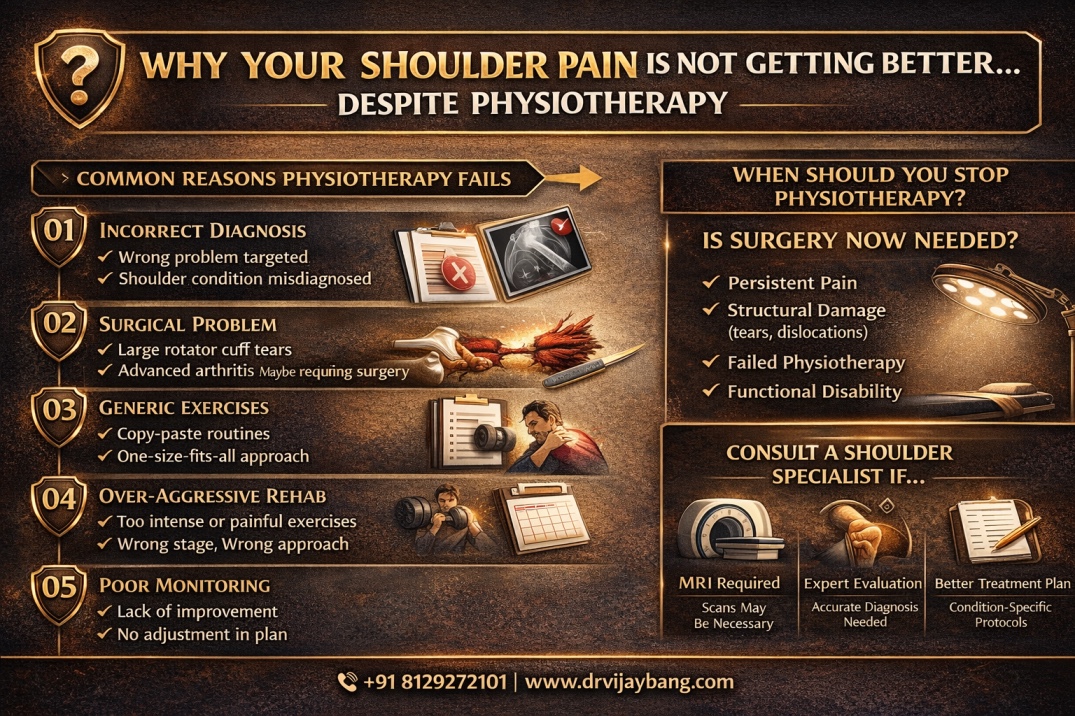
A Complete Guide for Patients Struggling with Persistent Shoulder Pain
Introduction
Shoulder pain is one of the most common musculoskeletal complaints seen in clinical practice. Many patients begin treatment with physiotherapy, expecting gradual relief. However, a large number of individuals return frustrated with the same concern:
👉 “Doctor, I’ve done physiotherapy for weeks or months… but my shoulder pain is not improving.”
This situation is not only common—it is clinically significant.
The truth is:
👉 Physiotherapy is highly effective—but only when used correctly, at the right stage, for the right diagnosis.
If your shoulder pain is not improving despite physiotherapy, it is often a sign that:
- The diagnosis may be incorrect
- The treatment approach may be inappropriate
- Or the underlying condition requires a different intervention
This comprehensive guide will help you understand:
- Why physiotherapy sometimes fails
- Common mistakes in shoulder pain management
- When to continue physiotherapy vs when to stop
- When surgery becomes necessary
Section 1: Understanding Shoulder Pain
What are the common causes of shoulder pain?
Shoulder pain is not a single disease—it is a symptom. The most common causes include:
1. Rotator cuff tear
- Partial or full tear of shoulder tendons
- Common in middle-aged and elderly patients
2. Frozen shoulder (adhesive capsulitis)
- Stiffness with severe restriction of movement
- Often seen in diabetics
3. Shoulder impingement syndrome
- Tendon gets compressed during movement
4. Shoulder arthritis
- Degenerative wear of joint
5. Shoulder instability
- Recurrent dislocations
Why is correct diagnosis critical before physiotherapy?
Because:
👉 Each shoulder condition requires a completely different treatment approach.
Example:
- Rotator cuff tear → strengthening + possible surgery
- Frozen shoulder → mobility exercises
- Impingement → posture correction
👉 Giving the wrong physiotherapy protocol can worsen the condition.

Section 2: Why Physiotherapy Sometimes Fails
1. Incorrect Diagnosis
This is the most common reason.
Patients are often told:
- “It’s just shoulder pain”
- “Do exercises and it will improve”
But without identifying the exact cause:
- Exercises may not target the problem
- Pain may persist or worsen
2. Treating a Surgical Problem Conservatively
Some conditions do not respond to physiotherapy alone, such as:
- Large rotator cuff tears
- Complete tendon rupture
- Advanced arthritis
👉 In these cases, physiotherapy can:
- Reduce pain temporarily
- But cannot fix the structural problem
3. Wrong Type of Physiotherapy
Not all physiotherapy is the same.
Common mistakes:
- Generic exercise routines
- Copy-paste protocols
- Lack of condition-specific rehab
4. Over-aggressive Exercises
Many patients:
- Do heavy resistance training
- Perform painful movements repeatedly
👉 This can worsen:
- Tendon tears
- Inflammation
5. Poor Compliance
Physiotherapy requires:
- Consistency
- Proper technique
- Long-term discipline
Skipping sessions or doing exercises incorrectly leads to poor results.
6. Lack of Progress Monitoring
Physiotherapy should be progressive and monitored.
If:
- Pain is not improving
- Function is not increasing
👉 Treatment plan must change.
Section 3: Condition-Specific Reasons for Failure
Why does physiotherapy fail in rotator cuff tears?
Because:
- Tendon damage may be structural
- Exercises cannot repair torn tissue
👉 Small tears may improve
👉 Large tears usually require surgery
Why does physiotherapy fail in frozen shoulder?
If:
- Wrong stage is treated
- Exercises are too aggressive
👉 It can increase pain and stiffness
Why does physiotherapy fail in shoulder impingement?
If:
- Posture is not corrected
- Root cause is not addressed
👉 Symptoms recur
Why does physiotherapy fail in arthritis?
Because:
- Cartilage damage is irreversible
👉 Exercises help temporarily but do not cure

Section 4: Signs That Physiotherapy Is Not Working
How do I know physiotherapy is failing?
Key warning signs:
- No improvement after 4–6 weeks
- Pain worsening with exercises
- Night pain increasing
- Reduced strength
- Limited movement
Is some pain normal during physiotherapy?
Mild discomfort = normal
Severe pain = warning sign
👉 Pain should gradually decrease, not increase
Section 5: Common Mistakes Patients Make
1. Self-prescribed exercises
Using:
- YouTube videos
- Internet routines
👉 May not suit your condition
2. Ignoring pain signals
Continuing exercises despite severe pain
3. Switching therapists frequently
No continuity in treatment
4. Delaying specialist consultation
Waiting too long worsens the condition
Section 6: When Should You Stop Physiotherapy?
Should you stop physiotherapy if pain persists?
Not immediately—but reassess if:
- No improvement in 4–6 weeks
- Symptoms worsening
- Functional limitation increasing
What should you do next?
👉 Consult a shoulder specialist
👉 Get proper evaluation (MRI if needed)
Section 7: Role of Imaging
When is MRI required?
MRI helps in:
- Detecting tears
- Assessing severity
- Planning treatment
Can diagnosis be made without MRI?
Sometimes yes, but:
👉 MRI confirms diagnosis and avoids guesswork
Section 8: When Surgery Becomes Necessary
When should surgery be considered?
- Failure of physiotherapy
- Structural damage
- Persistent pain
- Functional disability
Does delaying surgery worsen outcome?
Yes.
Delayed treatment can lead to:
- Muscle atrophy
- Irreparable tears
- Poor surgical results
Section 9: Correct Approach to Shoulder Pain
Step-by-step ideal approach
- Accurate diagnosis
- Condition-specific physiotherapy
- Regular monitoring
- Timely intervention
What is the goal of treatment?
- Pain relief
- Restore function
- Prevent progression
Section 10: Frequently Asked Questions
Why is my shoulder pain not improving with physiotherapy?
Because:
- Diagnosis may be wrong
- Condition may require surgery
- Exercises may be inappropriate
How long should physiotherapy take to work?
Typically:
- Improvement in 3–6 weeks
Can physiotherapy worsen shoulder pain?
Yes, if:
- Exercises are incorrect
- Condition is misdiagnosed
Should I continue physiotherapy despite pain?
Only mild pain is acceptable
Severe pain → reassessment needed
Is surgery better than physiotherapy?
Depends on condition
👉 Some cases need surgery
Section 11: Why Shoulder Specialist Matters
Why general treatment often fails?
Because shoulder is a:
👉 Highly specialized joint
Requires:
- Precise diagnosis
- Tailored treatment
Benefits of consulting a specialist
- Accurate diagnosis
- Better outcomes
- Avoid unnecessary delay
Section 12: Why Choose Dr. Vijay Bang
- Specialized in shoulder and knee surgery
- Extensive experience in complex shoulder cases
- Evidence-based treatment
- Transparent patient care
Conclusion
👉 If your shoulder pain is not improving despite physiotherapy, it is not normal.
It is a signal that:
- Something is being missed
- Or the treatment needs to change
Early intervention can:
✔ Prevent worsening
✔ Avoid surgery in some cases
✔ Improve outcomes significantly
Signature Block
Dr Vijay Bang
Shoulder and Knee Orthopedic Surgeon in Ahmedabad
www.drvijaybang.com
Call/whatsapp – +91 8129272101
(share your report on WhatsApp for trustable honest opinion)
Stay Connected with Dr. Vijay Bang for Regular Health Tips:
Instagram: https://www.instagram.com/drvijaybangortho
YouTube: https://www.youtube.com/@drvijaybangortho
Facebook: https://www.facebook.com/drvijaybangortho
Linkedin: https://www.linkedin.com/in/drvijaybangortho/
Keywords
shoulder pain not improving physiotherapy
why physiotherapy fails shoulder pain
rotator cuff tear treatment
frozen shoulder physiotherapy failure
shoulder pain treatment Ahmedabad
when to stop physiotherapy shoulder
shoulder specialist India
persistent shoulder pain causes
physiotherapy vs surgery shoulder