(The Truth Most Patients Are Not Told About Shoulder Injuries)
The Biggest Myth in Shoulder Treatment
One of the most common questions patients ask is:
“Doctor, can my rotator cuff tear heal without surgery?”
The honest, science-based answer is:
👉 In most cases — NO, it does not truly heal.
Yes, pain may reduce. Yes, movement may improve.
But actual tendon healing — where the torn tissue reattaches and becomes normal again — almost never happens naturally.
This misunderstanding is the root cause of delayed treatment, failed physiotherapy, and poor surgical outcomes later.
This article will explain in depth:
- Why rotator cuff tears don’t heal on their own
- The difference between feeling better vs actually healing
- When non-surgical treatment works (and when it fails)
- Why delays make surgery less successful
- Why choosing the right shoulder specialist matters
Who Is This Article Meant For?
This article is specifically written for:
- Patients with shoulder pain not improving with physiotherapy
- Individuals diagnosed with rotator cuff tear on MRI
- People told to “wait and watch”
- Athletes, gym-goers, and laborers with shoulder weakness
- Patients who had failed shoulder surgery
- Individuals confused between injection vs surgery
If you are experiencing:
- Night pain in shoulder
- Difficulty lifting your arm
- Weakness while holding objects
- Pain despite months of physiotherapy
👉 This article is for you.
Understanding the Rotator Cuff (Simple Explanation)
The rotator cuff is a group of four muscles and tendons that stabilize and move your shoulder.
These tendons attach muscle to bone — and this attachment is crucial.
When a rotator cuff tear happens:
👉 The tendon gets detached from the bone
That is the key problem.
The Core Question: Why Doesn’t It Heal Naturally?
Let’s go deep into the science.
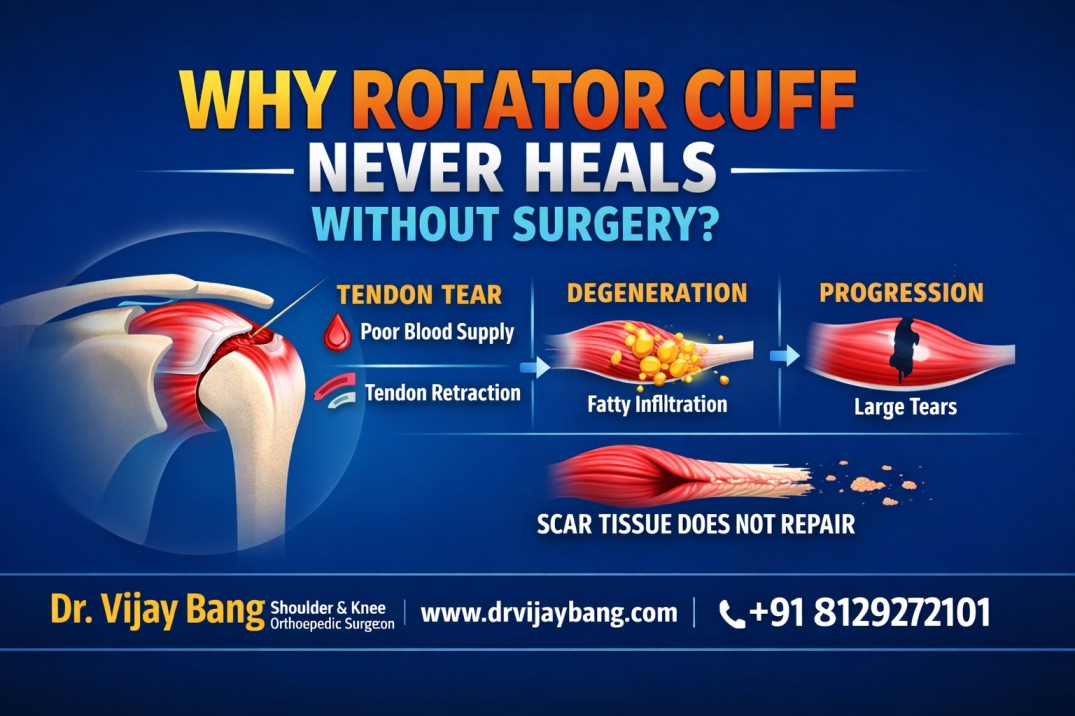
1. Poor Blood Supply = Poor Healing Capacity
Rotator cuff tendons have a very limited blood supply, especially near their insertion point.
And healing requires blood.
No blood = no healing.
This is why:
- Skin heals fast
- Muscle heals moderately
- Tendons heal very poorly
👉 Rotator cuff is among the worst healing tissues in the body
2. The Tendon Is Detached — It Cannot “Reconnect” Automatically
When a tendon tears:
- It pulls away from bone
- A gap forms
- The body cannot bridge this gap naturally
Unlike fractures where bone reconnects, tendons:
👉 Do NOT reattach themselves once completely torn
This is the most important concept patients misunderstand.
3. Continuous Movement Prevents Healing
Your shoulder is:
- The most mobile joint in the body
- Constantly in motion
Even small daily activities like:
- Eating
- Driving
- Using a phone
👉 Keep stressing the torn tendon
This prevents natural healing.
4. Degeneration — The Hidden Cause
Most rotator cuff tears are not sudden injuries.
They are:
👉 Wear-and-tear injuries over years
By age 50:
- Many people already have tendon degeneration
So when a tear happens:
- The tissue is already weak
- Healing potential is extremely low
5. Retraction of Tendon — The Silent Progression
After a tear:
- The tendon shrinks and retracts
- Muscles start pulling it away from bone
Over time:
👉 The gap increases
And once it becomes large:
- Even surgery becomes difficult
6. Fatty Degeneration — The Point of No Return
This is where most doctors fail to explain properly.
After prolonged tear:
- Muscle turns into fat
- Strength permanently reduces
This is called:
👉 Fatty infiltration
Once this happens:
❌ Even surgery cannot fully restore function
7. Scar Tissue ≠ Healing
Many patients say:
“Doctor, my pain reduced after physiotherapy, so I am healed.”
No.
What actually happens:
- Scar tissue forms
- Other muscles compensate
But:
👉 The tendon remains torn
This is functional improvement, not structural healing.
8. Large Tears Cannot Heal — Even With Surgery Sometimes
Even after surgery:
- Some rotator cuff tears fail to heal
- Especially large or chronic ones
So expecting natural healing without surgery is unrealistic.
Then Why Do Some People Feel Better Without Surgery?
This creates confusion.
Let’s clarify.
What Non-Surgical Treatment Actually Does
Non-surgical treatment includes:
- Physiotherapy
- Painkillers
- Steroid injections
These help by:
✔ Reducing inflammation
✔ Strengthening surrounding muscles
✔ Improving shoulder mechanics
But:
👉 They do NOT repair the torn tendon
The Dangerous Illusion of “I Am Better”
This is where most patients get trapped.
You may feel:
- Less pain
- Better movement
But inside:
👉 The tear is still present (and often worsening)
What Happens If You Ignore a Rotator Cuff Tear?
Over time:
- Tear size increases
- Muscle weakens
- Shoulder becomes stiff
- Arthritis develops
Eventually:
👉 You may need shoulder replacement instead of simple repair
When Can Rotator Cuff Heal Without Surgery?
Let’s be honest and balanced.
Some cases can improve without surgery:
1. Partial Tears
- Small tears may stabilize
- Symptoms can improve
2. Elderly Patients
- Low functional demand
- Pain control is priority
3. Patients Unfit for Surgery
But remember:
👉 Even in these cases, the tendon rarely becomes normal again
When Surgery Becomes Necessary
You should strongly consider surgery if:
- Full-thickness tear
- Persistent pain > 3 months
- Weakness in lifting arm
- Failed physiotherapy
- Young or active patient
Why Delaying Surgery Is a Big Mistake
Delaying leads to:
- Bigger tear
- Poor tissue quality
- Lower success rate
👉 Early surgery = better healing chances
Why Many Rotator Cuff Surgeries Fail
This is another harsh truth.
Even properly done surgeries may fail because:
- Tear was too large
- Tissue was degenerated
- Surgery done too late
👉 Timing and expertise matter more than anything
Why You Need a Shoulder Specialist (Not Just Any Orthopedic)
Rotator cuff is one of the most complex joints in the body.
General orthopedics is not enough.
You need:
- Accurate diagnosis
- Proper imaging interpretation
- Advanced surgical planning
👉 A dedicated shoulder surgeon makes a huge difference.
Why Choose Dr. Vijay Bang?
When it comes to shoulder problems, precision matters.
What Sets Dr. Vijay Bang Apart:
- Exclusive focus on shoulder and knee conditions
- Experience in handling complex and failed cases
- Strong emphasis on correct diagnosis before treatment
- Ethical approach — surgery only when necessary
- Trusted by patients across Gujarat and Rajasthan
Most Important Advantage:
👉 Not every rotator cuff tear needs surgery
👉 But every rotator cuff tear needs correct evaluation
The Reality Most Clinics Won’t Tell You
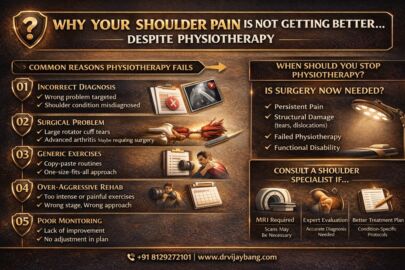
- Physiotherapy is not a cure for tears
- Injections give temporary relief
- Delaying treatment worsens outcomes
👉 The goal is not just pain relief — it is restoring function
Frequently Asked Questions
1. Can a rotator cuff tear heal on its own?
In most cases, a rotator cuff tear does not truly heal on its own because the tendon is detached from the bone and has poor blood supply. While symptoms like pain and stiffness may improve with physiotherapy or rest, the structural damage usually remains. The body cannot naturally reattach the tendon once it is completely torn. Some small or partial tears may stabilize, but they rarely return to normal anatomy. This is why many patients feel better but still have underlying damage.
2. Is physiotherapy enough for rotator cuff tear?
Physiotherapy can help improve shoulder strength, reduce pain, and enhance mobility. However, it does not repair the torn tendon. It mainly works by strengthening surrounding muscles to compensate for the injury. For small or partial tears, physiotherapy may be sufficient to manage symptoms. But for large or complete tears, it often fails to restore full function. Long-term reliance on physiotherapy without proper evaluation can delay necessary treatment.
3. What happens if a rotator cuff tear is left untreated?
If left untreated, a rotator cuff tear usually worsens over time. The tear can increase in size, and the tendon may retract further from the bone. Muscle degeneration and fatty infiltration can occur, making future repair difficult or impossible. Patients may develop chronic pain, weakness, and eventually shoulder arthritis. In advanced cases, shoulder replacement may be required instead of a simple repair. Early diagnosis is key to preventing these complications.
4. Do all rotator cuff tears require surgery?
No, not all rotator cuff tears require surgery. Partial tears and low-demand patients may be managed conservatively. However, full-thickness tears, persistent symptoms, and functional limitations often require surgical repair. The decision depends on age, activity level, tear size, and patient expectations. A proper clinical and imaging evaluation is essential before deciding treatment. Personalized treatment planning is crucial.
5. How do I know if my rotator cuff tear is serious?
Signs of a serious rotator cuff tear include persistent pain, inability to lift the arm, weakness, and night pain. If symptoms do not improve after weeks of rest or physiotherapy, it may indicate a significant tear. Imaging tests like MRI are required to confirm the diagnosis. Early consultation with a shoulder specialist helps prevent worsening. Ignoring symptoms can lead to irreversible damage.
6. Can injections cure rotator cuff tears?
No, injections cannot cure rotator cuff tears. Steroid injections may reduce inflammation and provide temporary pain relief. However, they do not repair the torn tendon. Repeated injections may even weaken the tendon further. They should be used judiciously and only as part of a broader treatment plan. Relying solely on injections is not a long-term solution.
7. What is the success rate of rotator cuff surgery?
Rotator cuff surgery generally has good success rates in terms of pain relief and function. However, actual tendon healing may not always occur, especially in large tears. Outcomes depend on tear size, tissue quality, and timing of surgery. Early intervention gives better results. Choosing an experienced shoulder surgeon significantly improves outcomes.
Final Takeaway
👉 Rotator cuff tears rarely heal naturally
👉 Pain improvement does not mean healing
👉 Delay reduces success of treatment
👉 Correct diagnosis is more important than treatment
About Dr. Vijay Bang
Dr Vijay Bang
Shoulder and Knee Orthopedic Surgeon in Ahmedabad
www.drvijaybang.com
Call/whatsapp – +91 8129272101
(share your report on WhatsApp for trustable honest opinion)
Stay Connected with Dr. Vijay Bang for Regular Health Tips:
Instagram: https://www.instagram.com/drvijaybangortho
YouTube: https://www.youtube.com/@drvijaybangortho
Facebook: https://www.facebook.com/drvijaybangortho
Linkedin: https://www.linkedin.com/in/drvijaybangortho/
Keywords
rotator cuff tear treatment, rotator cuff tear without surgery, shoulder pain not improving, rotator cuff surgery India, best shoulder surgeon Ahmedabad, partial vs full thickness tear, rotator cuff physiotherapy failure, shoulder injury treatment India, when to do rotator cuff surgery, rotator cuff healing chances